 | |
| Compiled by: Karel van der Waarde 2024 | |
| | |
| |
| | |
| Colofon & notes | |
|
|
Traffic signs
For roadsigns, comprehension and legibility are essential. Several studies show that these signs are not universal. Some are hard to read and could be improved. Testing is essential.

Dewar R, Pronin M. (2023) ‘Designing road sign symbols’. Transportation Research Part F: Psychology and Behaviour. 94, 466–491. [DOI].
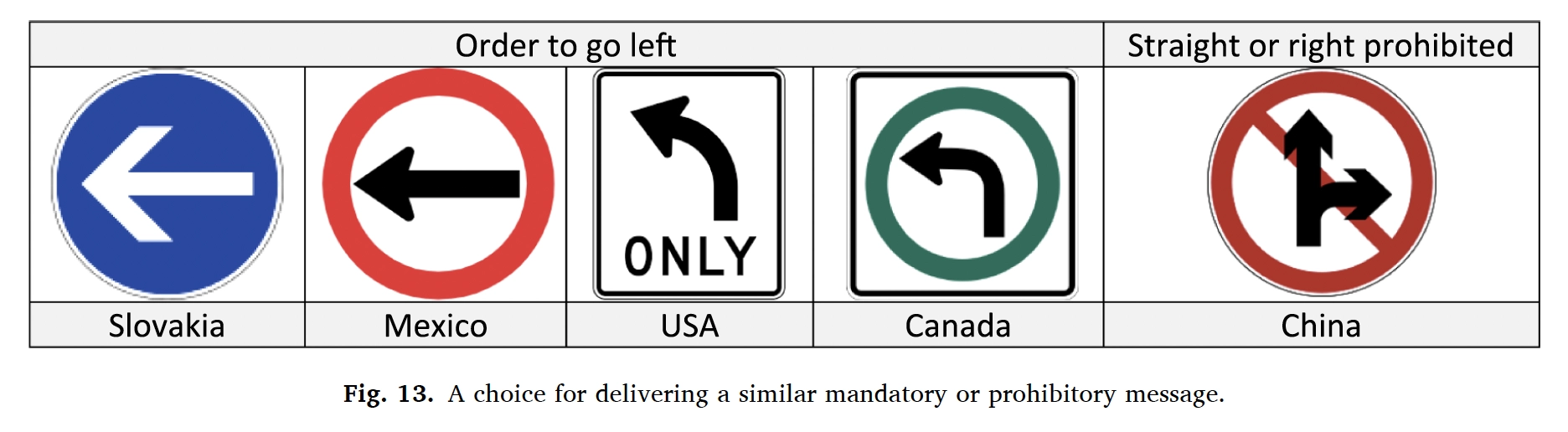
Aim of visuals: Effectiveness of road signs.
People: -
Method: It is an analysis of a very substantial collection of road signs.
Effect of visuals: It is often mistakenly assumed that symbols convey the intended information to people of all languages. In reality, the correct meaning of many symbols is not obvious to all. (page 483)
Suggestions for design: The article provides a list of recommendations for designing and evaluating roadsigns. And: ‘No substitute exists for true scientific testing of symbols for comprehension, and methodology is critical for obtaining trustworthy results. Reliable testing is usually not done due to cost and the time involved, and also to an assumption among many decision-makers in government that they can select good symbols without testing.’
Suggestions for policy: Road signs fail for 2 reasons: the symbol design itself and the symbol’s placement on the road sign.
Comment: For traffic signs, the article suggests: ‘local relevance is essential.’ + ‘The value of conducting thorough research, performing comprehension and legibility testing when possible, and exercising good judgment when approaching design projects cannot be underestimated.’
Trotter M, Burton J, Jones C, Frith B, Thomas J (Opus Research, Lower Hutt). (2017) ‘Drivers’ understanding of temporary and permanent slippery road signage’. NZ Transport Agency research report 607. [Website].
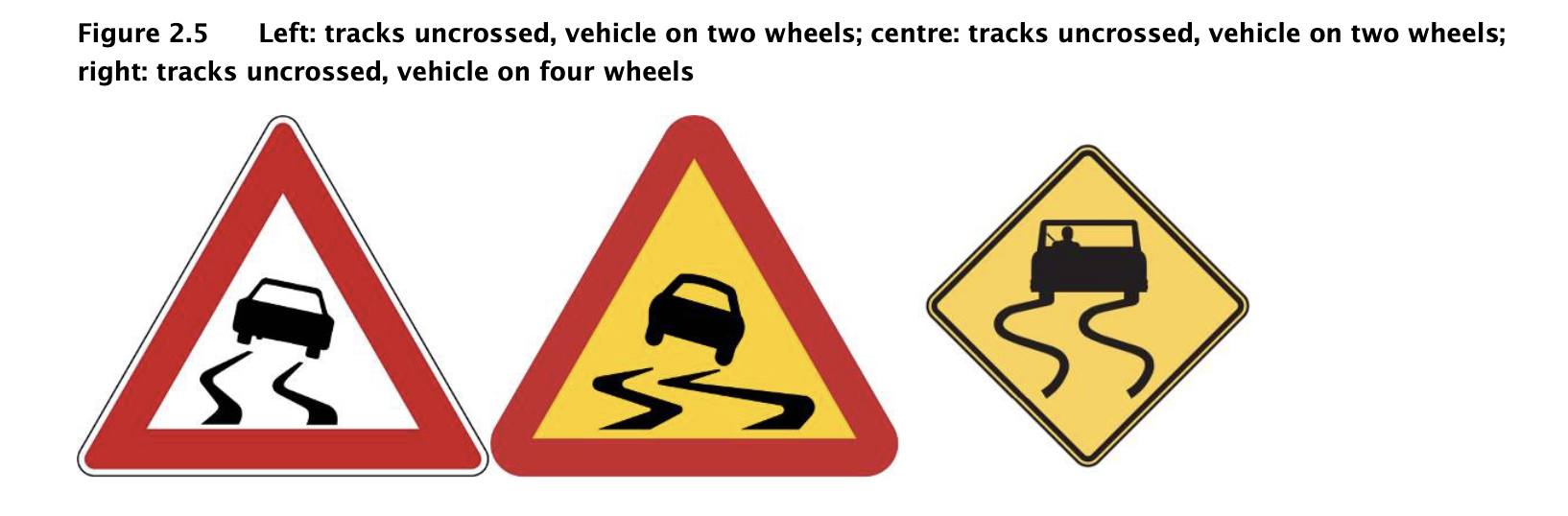
Aim of visuals: Warning drivers of the potential for lower skid resistance. (= ‘slippery road’)
People: New Zealand.
Method: Two interactive workshops (10 people + steering group), On road trials to measure speed.
Effect of visuals: Static signage can be effective in inducing the desired behavioural response (speed reduction.
Suggestions for design: -
Suggestions for policy: Selecting two alternative supplementary plates.
Comment: This study shows the variety of traffic signs that are used to indicate ‘slippery road’. The report mentions: ‘More recent studies, however, indicate traffic signs that include a combination of text and symbols are more likely to be correctly comprehended and are also comprehended faster than symbols alone (Shinar and Vogelzang 2013)’.
Hoekstra E, Williams M, Green P. (1993) ‘Development and Driver Understanding of Hazard Warning and Location Symbols for IVSAWS’. UMTRl The University of Michigan, Transportation Research Institute. Technical Report UMTRI-93-16. [PDF].
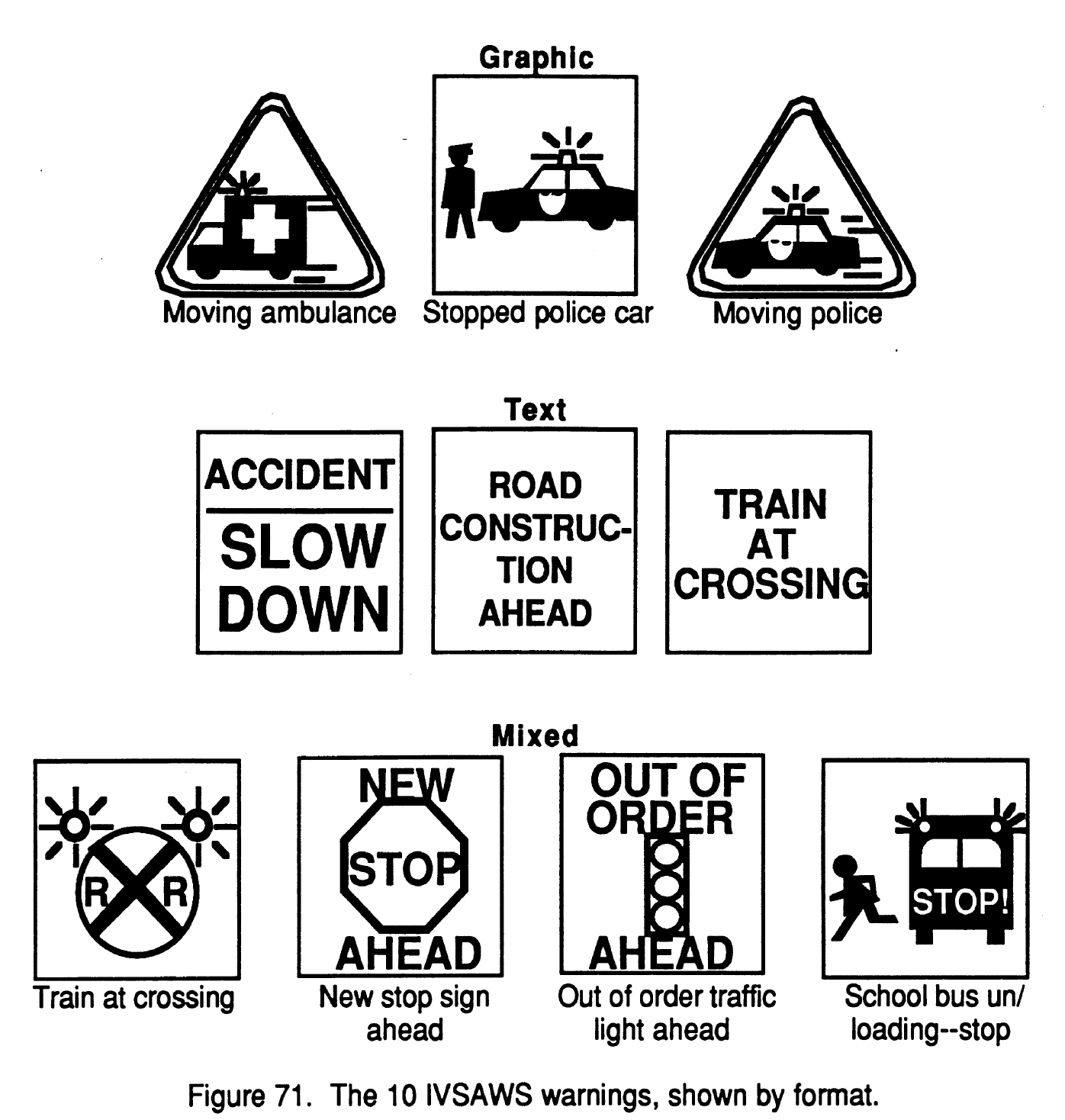
Aim of visuals: Warn car drivers about hazards.
People: 10 drivers drawing symbols for 30 hazards, 75 drivers did the ranking study, 20 drivers tested understandability,
Method: Drawing, ranking preference study, looking at symbols while driving
Effect of visuals: The hazard symbols were understood adequately.
Suggestions for design: Text for indicating relative hazard location is therefore recommended. In several cases for the poorer designs, the interpretation given by drivers was exactly the opposite of that intended.
Suggestions for policy:
Comment: This report shows the importance of participatory design and testing of traffic warning signs. Especially the drawings by participants, and the variation in testing methods is remarkable. The visual quality of the warnings that were tested is questionnable.
Shinar D, Vogelzang M (2013) ‘Comprehension of traffic signs with symbolic versus text displays’. Transportation Research Part F. 18, 72–82. [DOI].
Roca J, Insa B, Tejero P. (2018) ‘Legibility of Text and Pictograms in Variable Message Signs: Can Single-Word Messages Outperform Pictograms?’. Human Factors: The Journal of the Human Factors and Ergonomics Society. , . [DOI].