 | |
| Compiled by: Karel van der Waarde 2024 | |
| | |
| |
| | |
| Colofon & notes | |
|
|
Textile care labels
Textile labels might consist of several elements.
1. The International Association for Textile CareLabelling (GINETEX) is the world body which governs care labels since 1975. There is no universal care labelling system (Sanad, Young Kang, 2018). In 1990, GINETEX allowed ISO to incorporate the symbols into the ISO 3758 standard. The ISO 3758 in turn was adopted by CEN as a European standard ISO EN 37584.
2. Textile labels providing the material composition are mandatory in the EU for textiles intended for sale to the end consumer (Directive 1007/2011).
3. It might also be possible to add the EU Ecolabel to textile products.
There are many initiatives to develop textile labels. For example, Coats - a threads and fabric producer - provides an overview and adds another 28 symbols to show fabric performance codes. A report in 2020 casts doubt about the accuracy and usefulness of textile labels. The composition claims on the label were often incorrect, and the polystyrene labels make fabrics hard to recycle.

Sanad RA, Kang ZY. (2018) ‘An Analytical Study of National and International Care Label Systems of Textile and Apparel Products’. Fashion & Textile Research Journal. 20(3), 331-342 [DOI].
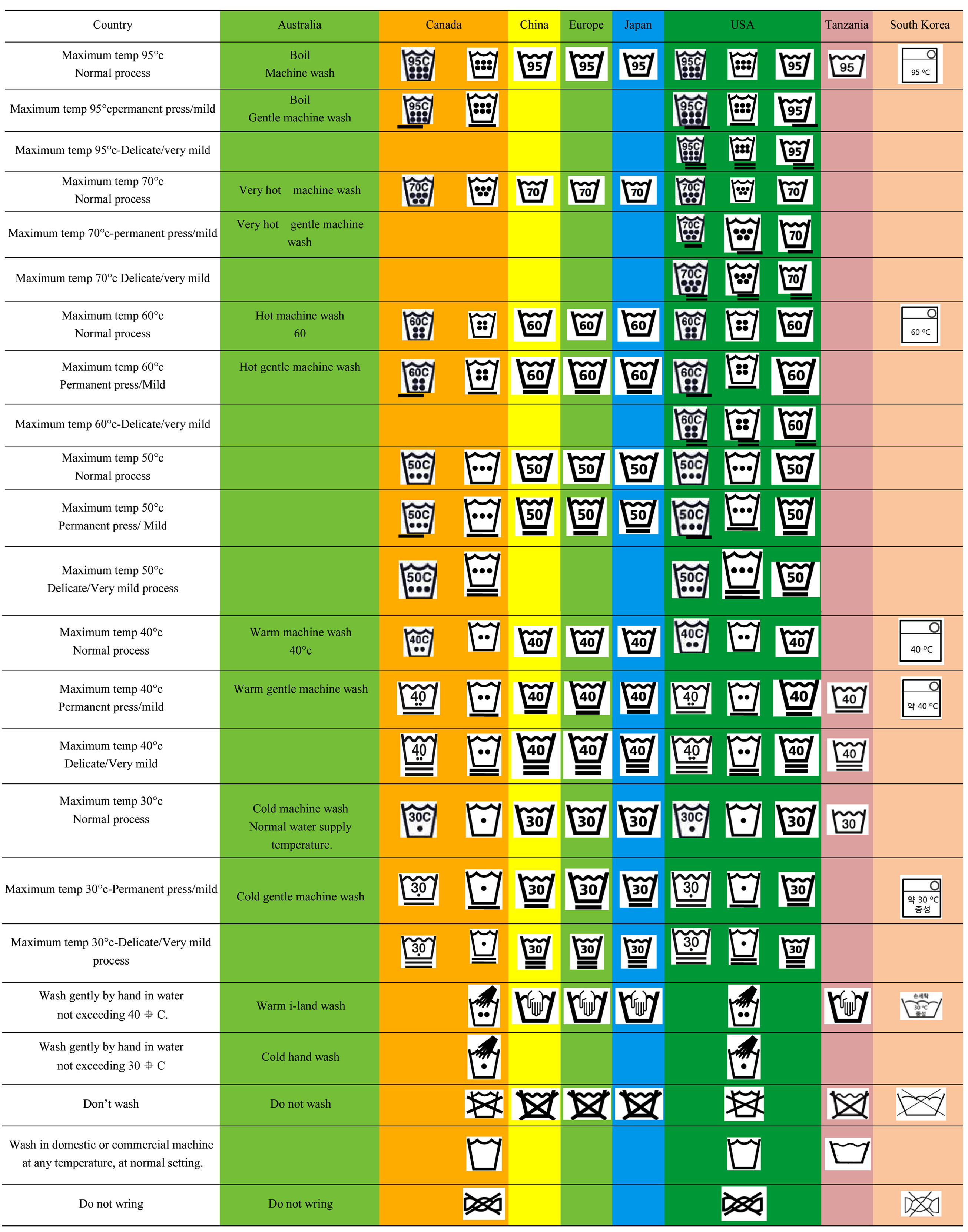
Aim of visuals: A care label is the kind of labelling instructing the consumer to the ideal conditions of caring the purchased item (mainly laundry process)
People: -
Method: Analysis of care labelling standards.
Effect of visuals: One point of view indicated the importance of using text in care labelling instructions. The highest comprehension and preference format was text only, followed by text and symbols format and only symbols format was the least. Another perspective showed the importance of presenting information employing pictogram which aid low literacy people to understand information on packaging design. However, it is evident that the current Australian standard published in 1998 (based on text). The most updated ones namely American and Japanese standards published in 2014 are based on symbols. This means that the update process should be investigated in order to develop care label symbols in proper and efficient way.
Suggestions for design: The differences between systems indicate that unification of symbols and meanings may be needed to provide global consumers consistent guidance.
Suggestions for policy: The article suggests that there is a need for universal textile care labeling.
Comment: Most current systems are based on symbols. It also suggests that a new system needs to feature inclusiveness and comprehensiveness, although it is not clear what is meant by that.
Hardy D, Wickenden R, McLaren A. (2020) ‘Electronic textile reparability’. Journal of Cleaner Production. 276, 124328. [DOI].
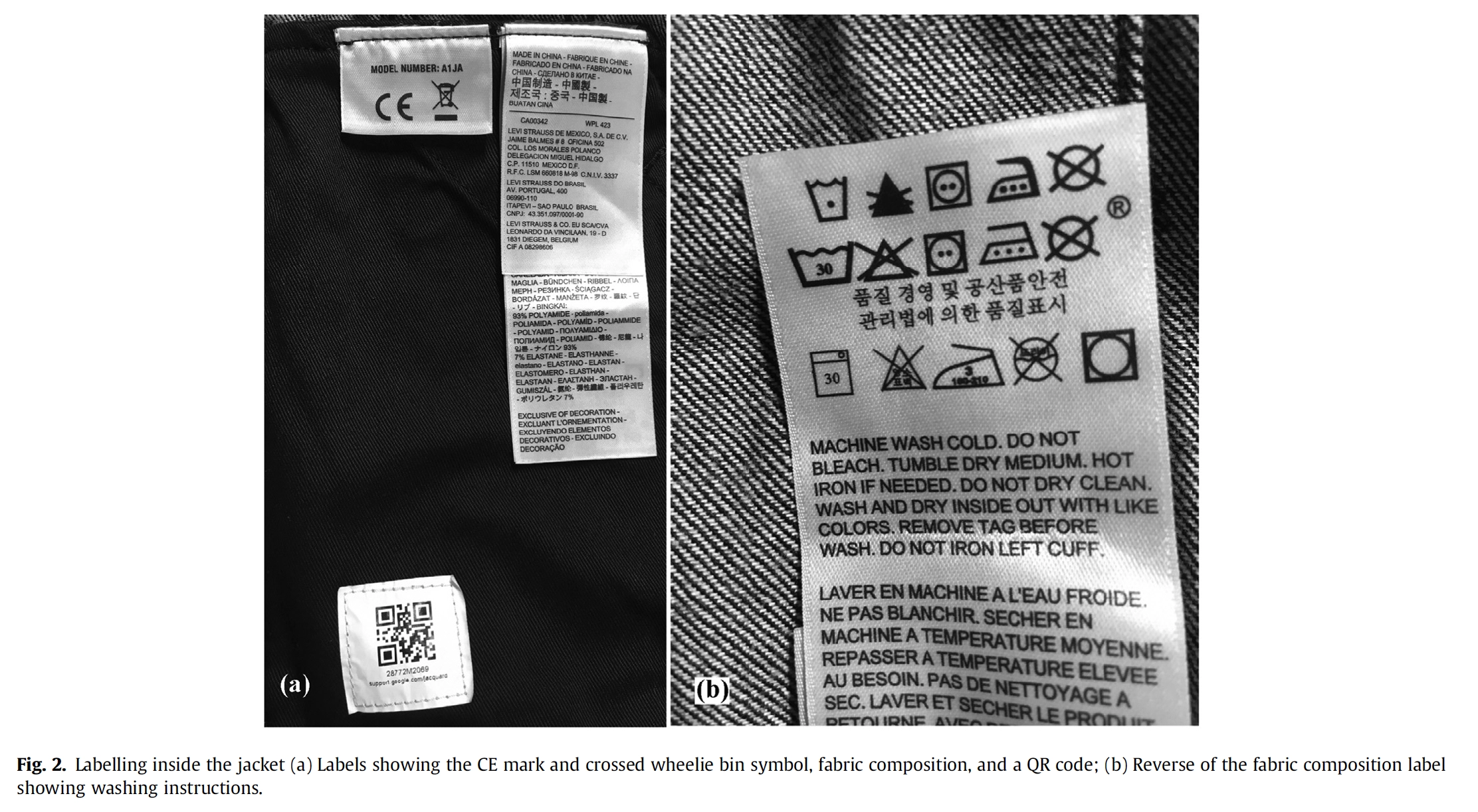
Aim of visuals: Amalgamation of electronics with textiles. Labelling can signpost consumers to the locations and function of electronics within E-textiles, as well as giving information about care and repair.
Method: Examination of three garments that combined electronics and textiles.
Effect of visuals: Labelling could inform users about appropriate care of the electronics within electronic textiles.
Suggestions for design: Given that care labels are often overlooked, this should be as clear as possible in original product swing tags and accompanying marketing materials, with links to other forms of support recommended.
Suggestions for policy: Development of new regulations for hybrid E-textile products would not only ensure correct care, maintenance and disposal but could also make repair more accessible.
Comment: It is likely that there will be more combination of textiles with other materials. The current labelling requirements hardly allow for this. As the authors state: ‘Ideally, labelling would provide signposting to repair, reuse and disposal instructions, with manufacturers providing repair services, warranties and take-back schemes.’
McLaren A, Goworek H, Cooper T, Oxborrow L, Hill H. (2016) ‘The effect of consumer attitudes on design for product longevity: The case of the fashion industry’. in Lloyd P, Bohemia E. (eds.) Future Focused Thinking - DRS International Conference 2016. 27-30 June, Brighton, United Kingdom. [DOI].
Aim of visuals: Extending garments’ active life via design, maintenance and re-use of clothing is the most effective method of reducing the negative effects of the clothing industry on the environment.
People: Consumers aged 18-35-years associated with ‘fast fashion’ consumption; Parents with children of school age; Consumers aged 30-60-years with a focus on classic clothing.
Method: Focus groups: 29 participants in three groups, UK.
Effect of visuals: Care labels were rarely followed by the research participants beyond first wash and many
found them difficult to understand.
Suggestions for design:
Suggestions for policy:
Comment: The effect is based on the statements of 29 people. It only provides an indication. No visuals are shown.
Nayak R, Padhye R. (2015) ‘Care labelling of clothing’. pp 427–446 in Nayak R, Padhye R. (eds.) Garment Manufacturing Technology. Woodhead Publishing Series in Textiles. Woodhead Publishing. [DOI].
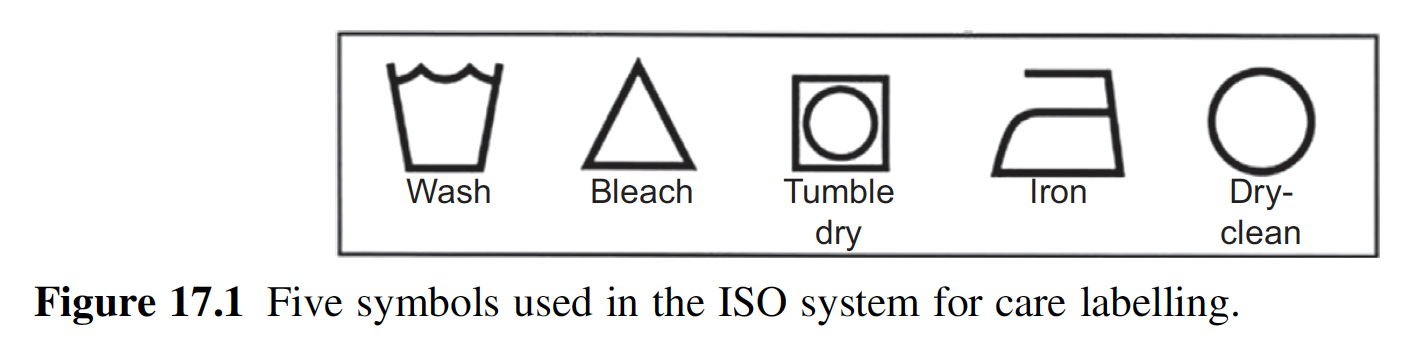
Aim of visuals: Care labels that are easily understood by consumers increase their confidence in caring for the apparel and reduce their perceptions of risk concerning the purchase of the item.
People: -
Method: -
Effect of visuals: A survey found that many people do not fully understand care label information and select more vigorous cleaning methods than those recommended.
Suggestions for design: -
Suggestions for policy: Several studies have demonstrated no existence of a direct relationship between information provided and information used.
Comment: Unclear which survey the text refers to.
Yan R-N, Yurchisin J, Watchravesringkan K. (2008) ‘Use of care labels: linking need for cognition with consumer confidence and perceived risk’. Journal of Fashion Marketing and Management. 12(4), 532-544. [DOI].
Aim of visuals: An effect of apparel care label information presentation formats (i.e. symbols only, text only, and the combination) and the individual trait of need for cognition on consumers’ confidence in and risk perceptions about the post-purchase activity of care of apparel items.
People: 275 undergraduate students, USA.
Method: three versions of a questionnaire: symbols only, text only, both symbols and text. All on 7-point likert scale.
Effect of visuals: The findings of this research suggest not only that the text only format and the combination of text and symbols format are preferred to the symbols only format but also that the text only format was the most preferred among the three formats. Both the text only format and the combination format significantly increased consumers’ confidence in and reduced consumers’ risk perceptions about their care of apparel items
Suggestions for design:
Suggestions for policy:
Comment: Questionnaire and Likertscales: preferences, confidence & risk-perceptions. Not recognition, understanding, or intention for action. The questionnaires are not shown: it is unknown what the students looked at.
Feltham TS, Martin LA. (2006) ‘Apparel Care Labels: Understanding Consumers’ Use of Information’. Marketing. 27(3), 231-244. [Website].
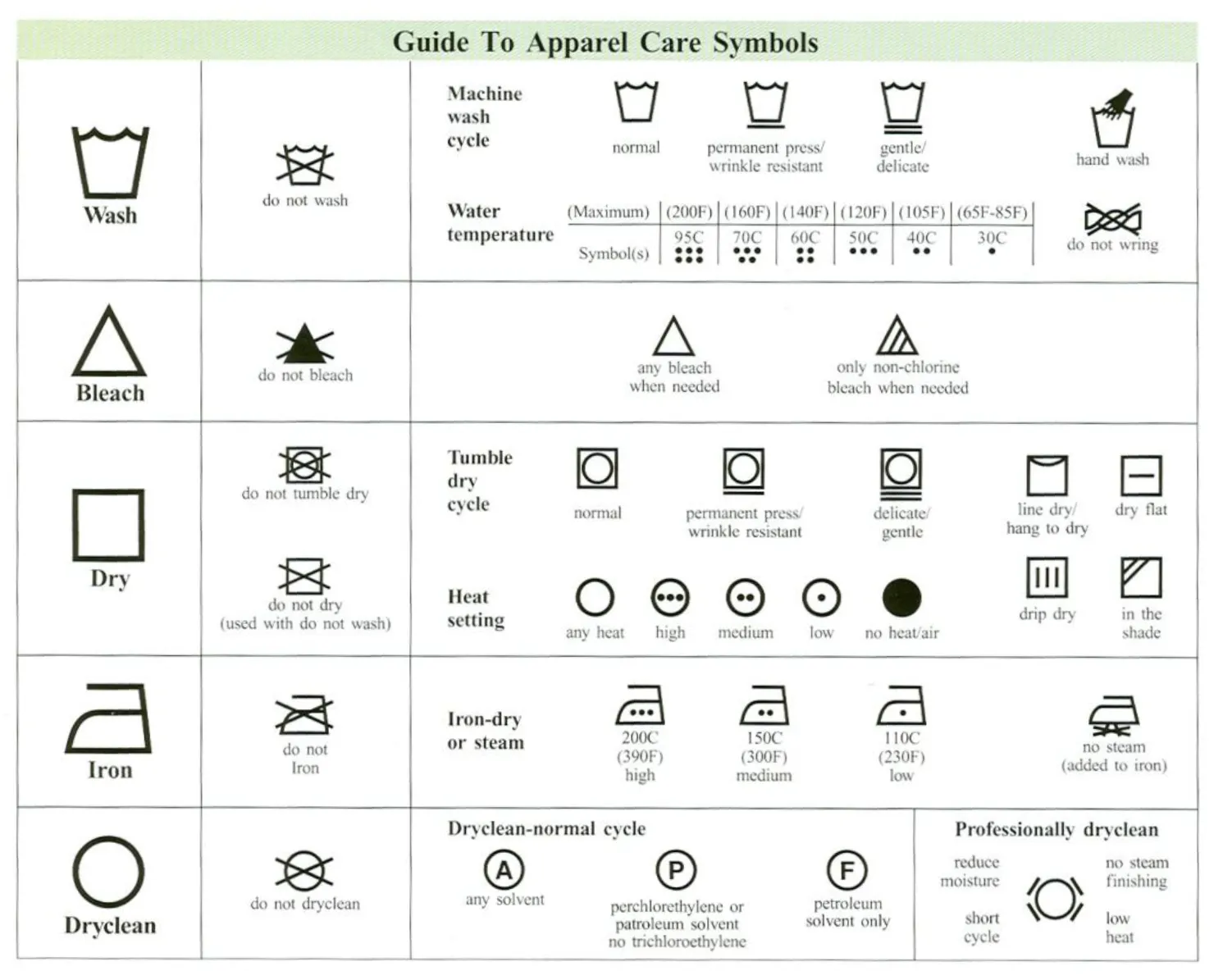
Aim of visuals: Providing information on size, fibre content and care methods.
People: Canada.
Method: 805 telephone survey, 16 consumers in focus group and individual interviews.
Effect of visuals: Reactions to the new CGSB symbols indicated a high level of non-comprehension. When presented with the newly adopted CGSB symbols, focus group participants were overwhelmed with the number of symbols. Participants noticed similarities to the older labelling system and wondered why a change was
necessary. They were also surprised and concerned that the symbols would not be in colour. Participants did not think many of the symbols were intuitively linked to their meaning.
Suggestions for design: These younger participants expressed the preference for care labels that are written out in words. Symbols need to be with words, in colour, not complicated, and intuitive.
Suggestions for policy: The attempt to communicate without color and without words in a very limited space may not be accomplishing the goal of providing consumers with the type and amount of information they need to make decisions about clothing purchases and later care.
Comment: Differences between ‘experienced’ and ‘younger’ consumers is interesting.
Shin, S. (2000) ‘Consumers’ Use of Care-label Information in the Laundering of Apparel Products’. The Journal of The Textile Institute. 91(1), 20-28. [DOI].
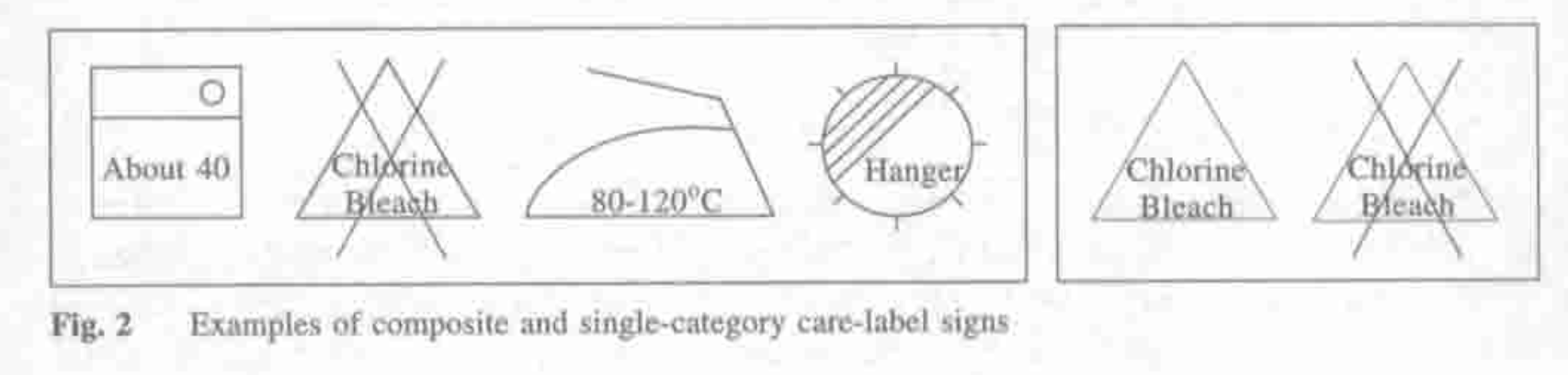
Aim of visuals: Providing simple but specific and clear instructions for the use and care of textiles
and clothing products.
People: 166 people, Korea
Method: Five part questionnaire.
Effect of visuals: About one-third (35.8%) of respondents said they were satisfied with the current care labels, but some suggested improvements for care labels: additional letters of explanation with signs (26.7%), changing signs for ease of understanding (19.4%), and letters of explanation instead of signs (15.2%). Those who know the signs on care labels will follow the instructions correctly in actual laundering.
Suggestions for design: It is therefore very important to provide simple and information-rich care labels that can be understood easily and clearly, leading to increased consumer use of the label information in actual laundering, as this study implies.
Suggestions for policy: -
Comment: 35,8% were satisfied; It is unclear how 'simple and information-rich care labels' can be designed, nor how this relates to 'understood easily and clearly.' That is wishful thinking that is not based on the findings.