 | |
| Compiled by: Karel van der Waarde 2024 | |
| | |
| |
| | |
| Colofon & notes | |
|
|
Sustainability labels
A 2024 report by the Joint Research centre identified 210 sustainability labels in the food market.

Thøgersen J, Dessart FJ, Marandola G, Hille SL. (2024) ‘Positive, negative or graded sustainability labelling? Which is most effective at promoting a shift towards more sustainable product choices?’. Business strategy and the environment. 1-19. [DOI].
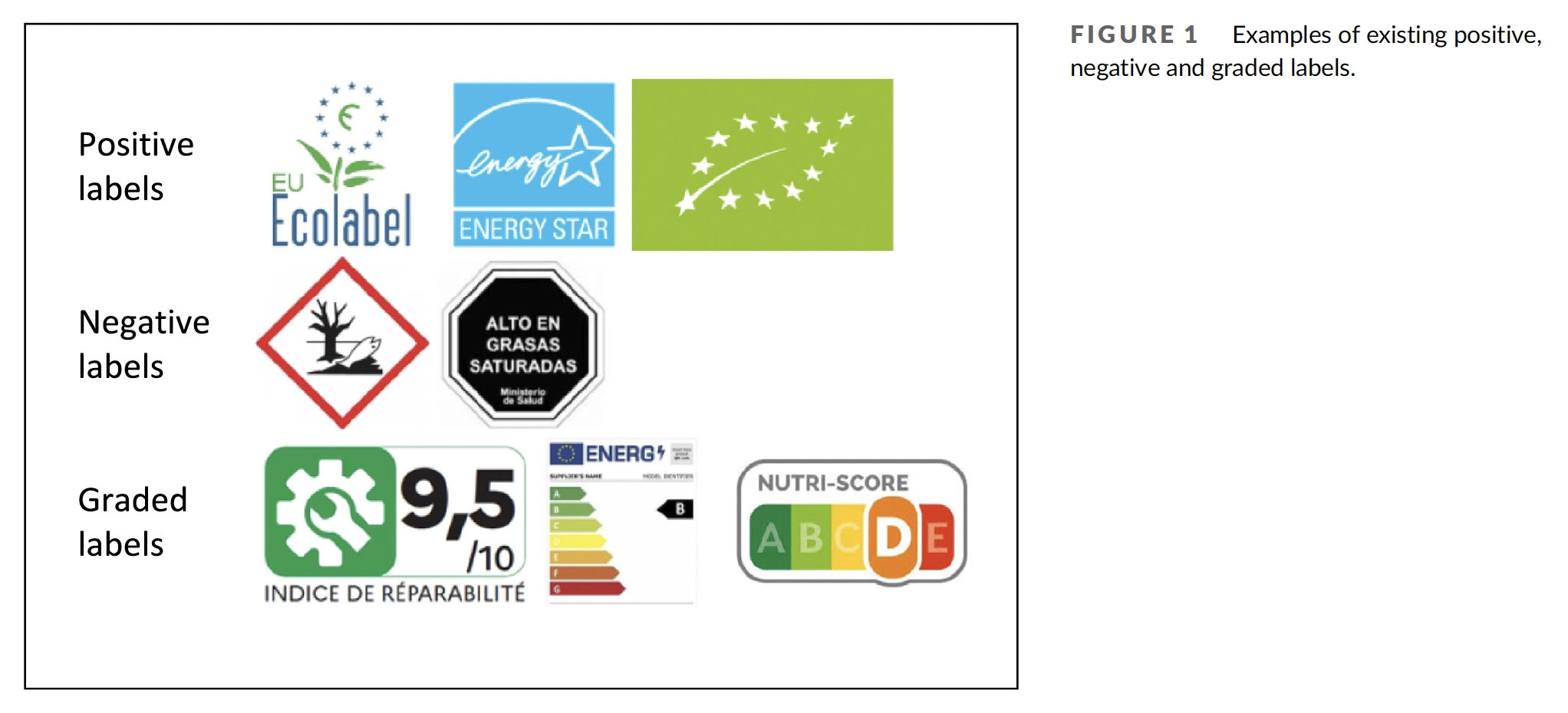
Aim of visuals: Sustainability labels convey information about different product attributes, such as its environmental impact, lifespan or ethical performance. Three formats: positive, negative, or graded.
People: 1243 consumers from Germany, Spain and the Czech Republic.
Method: an incentive-compatible online discrete choice experiment (= investigating how variable product attributes impact consumer preferences and choices.)
Effect of visuals: Compared with positive and negative labels, graded labels were most effective in guiding consumers towards more sustainable product choices. This research strongly supports the use of graded, traffic light-coloured sustainability labelling, which clearly outperform other labelling types at making the sustainable choice the easy choice, for businesses and their customers.
Suggestions for design: None
Suggestions for policy: ‘Based on our research, we urge governments, businesses and other stakeholders to speed up their testing and implementation of effective sustainability labelling.’
Comment: The study asks for online preferences. The relation with actual behaviour is unknown.
Agost M-J, Vergara M, Bayarri V. (2023) ‘Analysis of perceptions of sustainable labeling according to product type’. KEER 2022 | 9th international conference on kansei engineering and emotion research 2022. 97-106. [DOI].
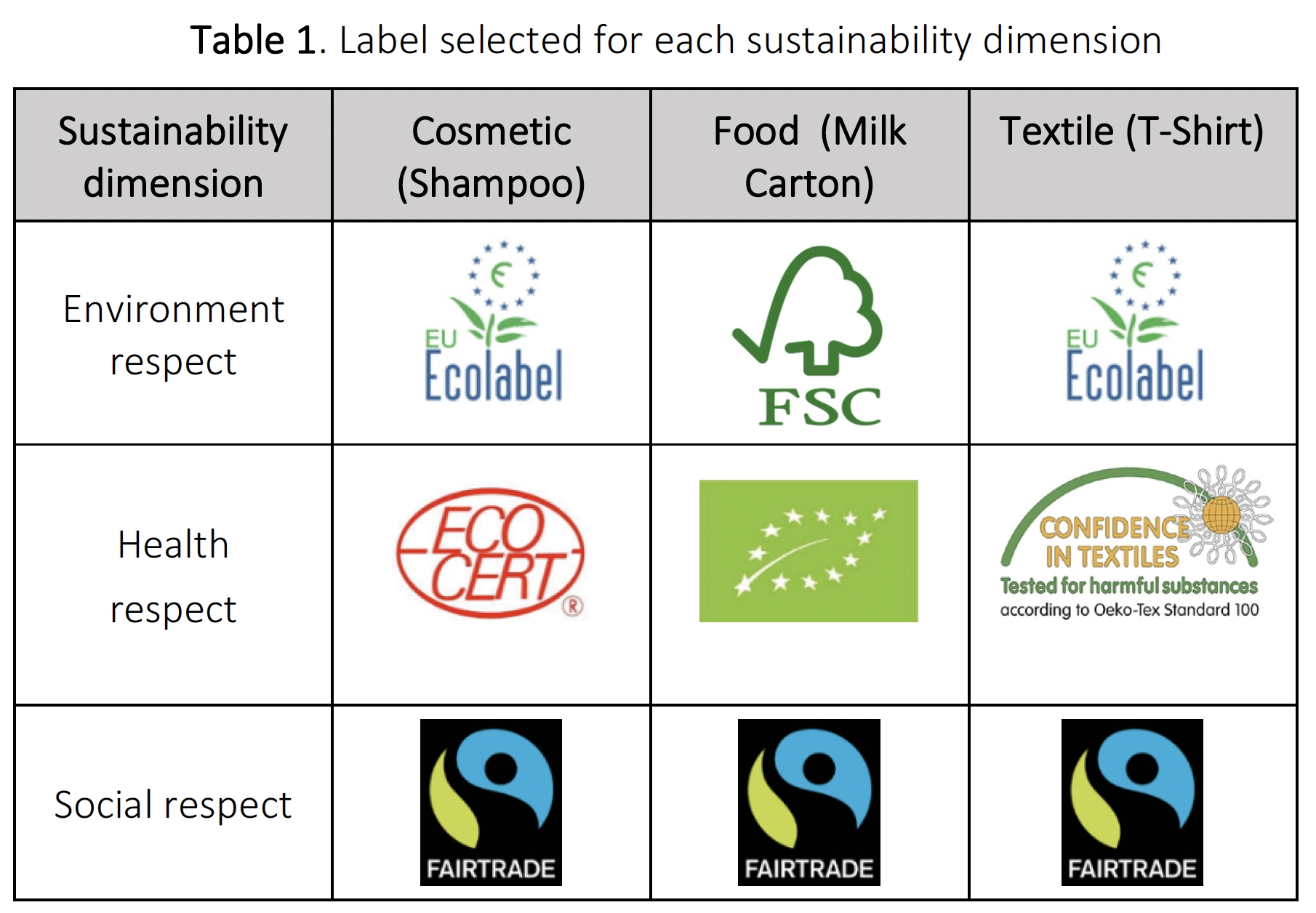
Aim of visuals: Comparing 3 sustainable labels (environmental, social or related to health) on 3 products: food (a milk carton), clothing (a T-shirt) and a personal hygiene product (a bottle of shampoo). Do the same labels cause the same perceptions, depending on the type of product that displays them?
People: 73 Spanish participants: students and university staff.
Method:
Effect of visuals: The preferred sustainability aspect depends on the product.
Suggestions for design:
Suggestions for policy: The evaluation and decision criteria of sustainable labeling may vary, depending on the type of product to which it is applied.
Comment:
Annunziata A, Marinani A, Vecchio R. (2019) ‘Effectiveness of sustainability labels in guiding food choices: Analysis of visibility and understanding among young adults’. Sustainable Production and Consumption. 17, 108–115. [DOI].
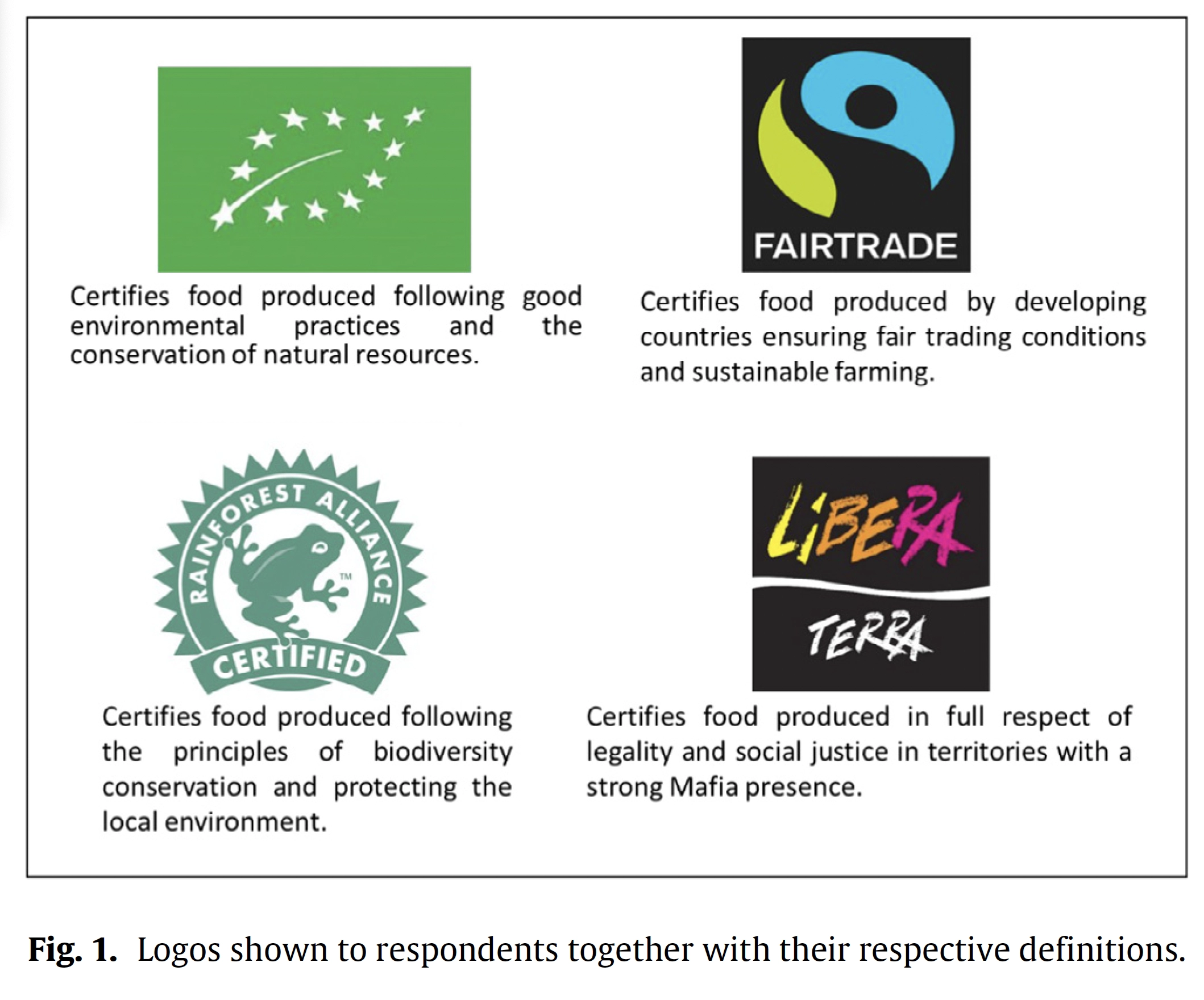
Aim of visuals: ‘factors that determine attention to, and understanding of, four sustainability labels (organic, Rainforest Alliance, Fair Trade and Libera Terra) among young adults (18–26 years).
People: Italy, 305 individuals between 18 and 26.
Method: Online survey (survey monkey). Seen before? Select meaning out of 3 responses or don’t know. Opinion on clarity and utility.
Effect of visuals: Visibility: organic: 60% (44% correct answer about meaning), Fair trade: 56% (15% correct answer). Exposure affects understanding (page 111).
Suggestions for design: Footnote 10 on page 114 is interesting: ‘The selection of the logo followed a broad participatory procedure. The UE launched during 2009 a competition amongst students of art and design from Member States, to gather proposals for a new logo. Then different logos were proposed and chosen by the visitors of the website; subsequently the most chosen
logo was adopted as the new organic production logo of the European Union within Regulation 271/2010.’
Suggestions for policy: Page 114: ‘Policy makers should also provide public information campaigns to assist consumer education towards sustainable food in general and sustainability labelled products in particular.’
Comment: Alas, the questionnaire is not available. It is unclear how the labels were shown. Unclear how ‘clarity and utility’ were measured. Relation with practice is not discussed.
Majer JM, Henscher HA, Reuber P, Fischer-Kreer D, Fischer D. (2022) ‘The effects of visual sustainability labels on consumer perception and behavior: A systematic review of the empirical literature’. Sustainable Production and Consumption. 33, 1-14. [DOI].
Aim of visuals: ‘Reliably informing the consumers about the performance of a product regarding a range of environmental, ethical, or social aspects.’
Method: A systematic review. 26 articles. Across thewhole sample, a total of 48 unique labels was investigated. 13 were fictional and designed for the research project.
Effect of visuals: Labels do have positive effects on psychological and behavioral outcome variables.
Suggestions for design: Their effects vary widely in size and depend on a variety of individual, contextual, and label characteristic factors.
Suggestions for policy: ‘Among the largest barriers to sustainable consumption is the lack of knowledge and inability to differentiate between claims, labels, and other certification standards’.
Comment: ‘Our findings reveal that the majority of studies focused predominantly on how labels affect consumer evaluations and behavioral intentions, whilst only few studies examined actual human purchase behavior itself.’ The visuals are not in the main article, but included in table 1 in the supplementary materials.
Niero M, Hauschild MZ. (2017) ‘Closing the loop for packaging: finding a framework to operationalize Circular Economy strategies’. Procedia CIRP 61. The 24th CIRP Conference on Life Cycle Engineering. 685-690. [DOI].
Aim: Discussion of Circular economy: which frameworks to use?
Effect of visuals: None yet.
Suggestions for design: None yet.
Suggestions for policy: Use the ‘Life Cycle Sustainability Assessment framework’ to evaluate circularity strategies, since it is the most comprehensive and still operational framework and best at preventing burden shifting between stakeholders in the value chain.
Comment: This LCSA might be a basis for the development of an environmental/sustainability/circularity label?