 | |
| Compiled by: Karel van der Waarde 2024 | |
| | |
| |
| | |
| Colofon & notes | |
|
|
Material indicators: compostable materials

Allison AL, Băitanu A, Purkiss D, Lorencatto F, Michie S, Miodownik M. (2024) ‘Enabling desired disposal of compostable plastic packaging: an evaluation of disposal instruction labels’. Frontiers in Sustainability. 5, 1376519. [DOI].
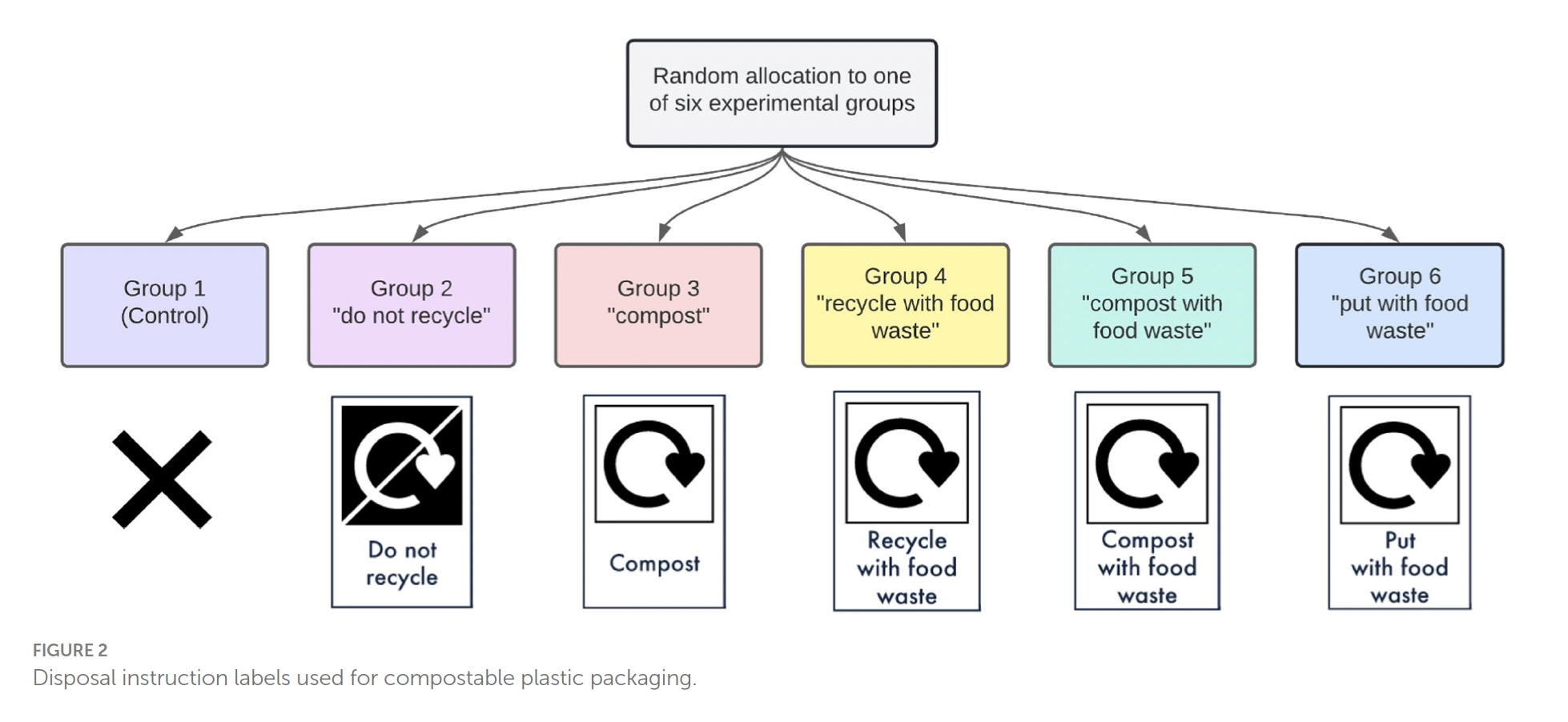
Aim of visuals: The desired disposal of compostable plastic packaging.
People: 1008 UK citizens.
Method: Mixed method: online experiment and questionnaire.
Effect of visuals: Findings suggest that citizens struggle to identify compostable plastic packaging from appearance alone. Clear direct disposal instruction wording can help enable the appropriate disposal behaviours.
Suggestions for design: The depiction of simple yet unambiguous and instructive symbols was valued and likely to be the better instigators of behaviour change compared with associative symbols. Participants felt that a logo
alone would be insufficient as a disposal instruction strategy and emphasised the importance of written disposal instructions to reduce any potential confusion.
Suggestions for policy: If a separate compostability logo comes into practice, it will be important for this
to be as direct, explicit, and comprehensive as possible.
Comment: The wording of the instructions is of course important if the symbol is identical ...
Mhaddolkar N, Tischberger-Aldrian A, Astrup TF, Vollprecht D. (2024) ‘Consumers confused ‘Where to dispose biodegradable plastics?’: A study of three
waste streams’. Waste Management & Research. , 1-12. [DOI].
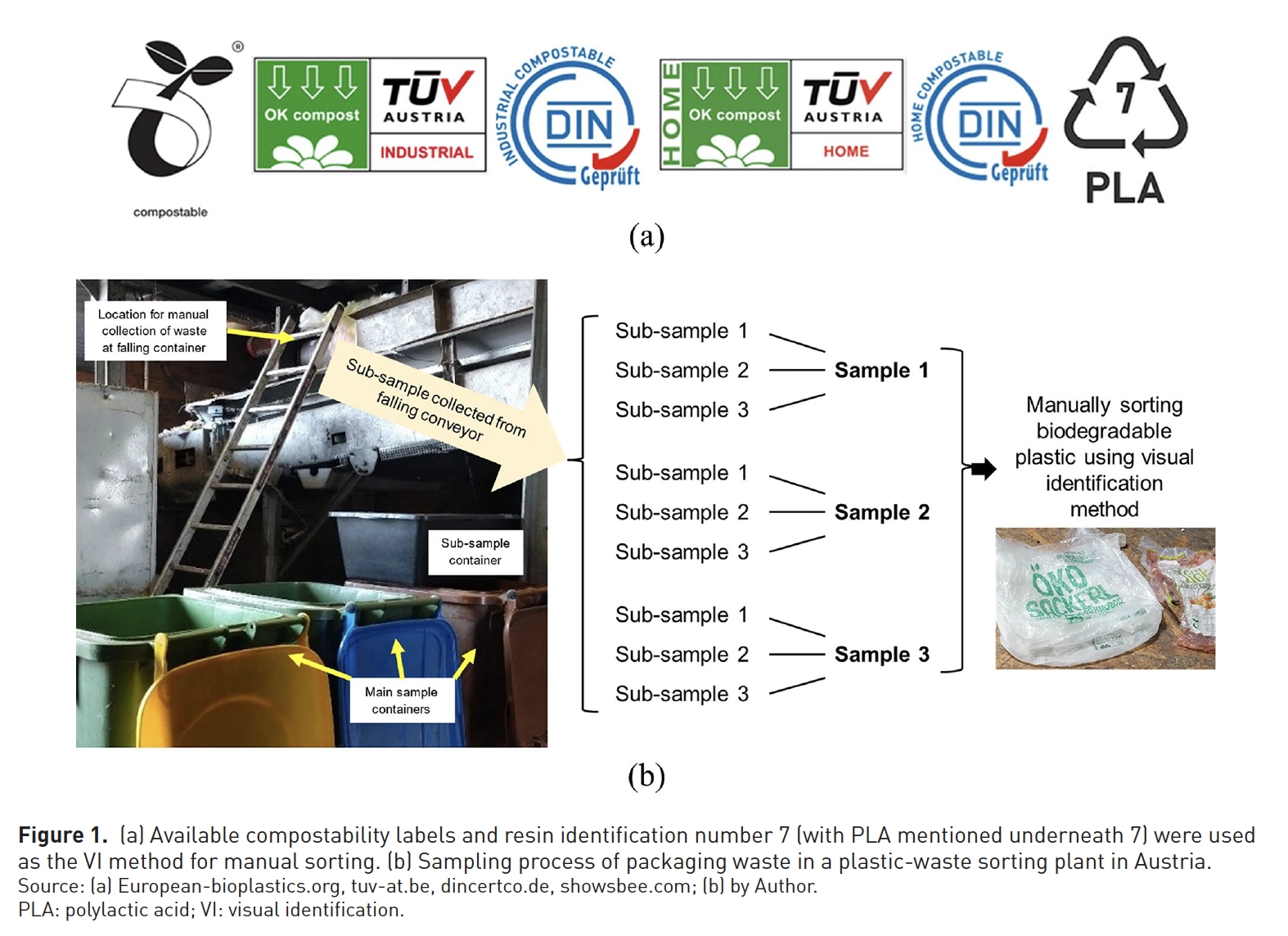
Aim of visuals: Consumers are not necessarily aware of how-to source-separate the biodegradable plastics.
People: Austria. Analyses of waste sampled from packaging waste (P), biowaste (B) and residual waste (R) in an urban area of Austria
Method: Conducting sampling and manual sorting analyses in an urban area in Austria and sorting trials using a near-infrared machine in an urban area in Germany.
Effect of visuals: The results indicate that certain bioplastic items were present in more than one bin.
Suggestions for design: These results suggest consumers’ confusion based on the distribution of specific items in more than one bin.
Suggestions for policy: The article states: ‘The label-less claims were greenwashing examples, which falsely
claimed to be biodegradable without any compostability labels to support them.’ The authors conclude: ‘Thus, it could be inferred that assuming consumers are willing to correctly dispose of the bioplastics, the availability of correct
(and uniform) sorting instructions is crucial to reduce this confusion.’
Comment: Make sure that ‘biodegradable’ is correctly indicated and that there is no confusion.
Cristóbal J, Albizzati PF, Giavini M, Caro D, Manfredi S, Tonini D. (2023) ‘Management practices for compostable plastic packaging waste: Impacts, challenges and recommendations’. Waste Management. 170, 166-176. [DOI].
Aim of visuals: Bioplastic waste collection and management practices are still far from full-development and harmonisation. It is assumed that citizens are able to recognise CPPs and behave accordingly to the mandated instructions for separate waste collection.
People: -
Method: -
Effect of visuals: To increase participation, labels and pictograms play an important role. But consumers might misunderstand biodegradability or compostability claims as a ‘licence to litter’.
Suggestions for design: To this, clear labelling and sorting instructions for citizens are a precondition along with awareness-raising and information campaigns at national level to increase participation to the source-segregation overall.
Suggestions for policy:
Comment: Example of the assumption ‘Clear labelling’ is unproblematic, and that citizens need to be educated.
Allison AL, Lorencatto F, Michie S, Miodownik M. (2021) ‘Barriers and Enablers to Buying Biodegradable and Compostable Plastic Packaging’. Sustainability. 13, 1463. [DOI].
Aim of visuals: Biodegradable and compostable plastic packaging (BCPP): Barriers: not understanding terminology used to label packaging, not taking notice of packaging, and preferring other types of packaging and product qualities
People: UK
Method: Analysis of a part of 5176 participant survey responses
Effect of visuals: Only terminology.
Suggestions for design: Reducing ambiguity concerning the labels of biodegradable and compostable may reduce skepticism over environmental claims of packaging. Interventions should improve information about the source of the packaging material, how the packaging waste is processed, and how to dispose of the packaging. we suggest designing packaging based on usercentred needs for transparency.
Suggestions for policy: we suggest policies that focus on improving the current waste infrastructure e.g., potentially adapting existing food waste management streams to accommodate compostable plastics.
Comment: Terminology needs attention: biodegradable and compostable? ‘Barriers and enablers’ approach is interesting.
The UK Plastics pact (2021) ‘Barriers and Enablers to Buying Biodegradable and Compostable Plastic Packaging’. Banbury: WRAP. PDF. [UK: ‘Labelling exists only in the form of the certifications for compostability and these labels are unlikely to be understood by the majority of citizens.’]