 | |
| Compiled by: Karel van der Waarde 2024 | |
| | |
| |
| | |
| Colofon & notes | |
|
|
ECO labels
The EU Ecolabel, established in 1992, is the EU official voluntary label for environmental excellence. The overarching goal of the EU Ecolabel is to empower market actors to consume, produce and live more sustainably and to engage them in the transition towards a circular economy. The goal of ecolabelling is to inform on the superior standard of environment-friendly parameters of ecolabelled products and to encourage consumers and producers to produce or use these products. Regulation (EC) No 66/2010 provides the legal basis. The illustrations below show that ‘ecolabels’ and ‘energy labels’ are confusing. Both are used interchangeably but both have different intentions and different meanings. A review of 30-years of eco labelling was published in 2022.

Forleo MB, Plamieri N. (2024) ‘Eco-Labeled Canned Tuna Consumption: What do Italians Know and How do They Behave?’. Journal of International Food & Agribusiness Marketing. 36(3), 550-572. [DOI].
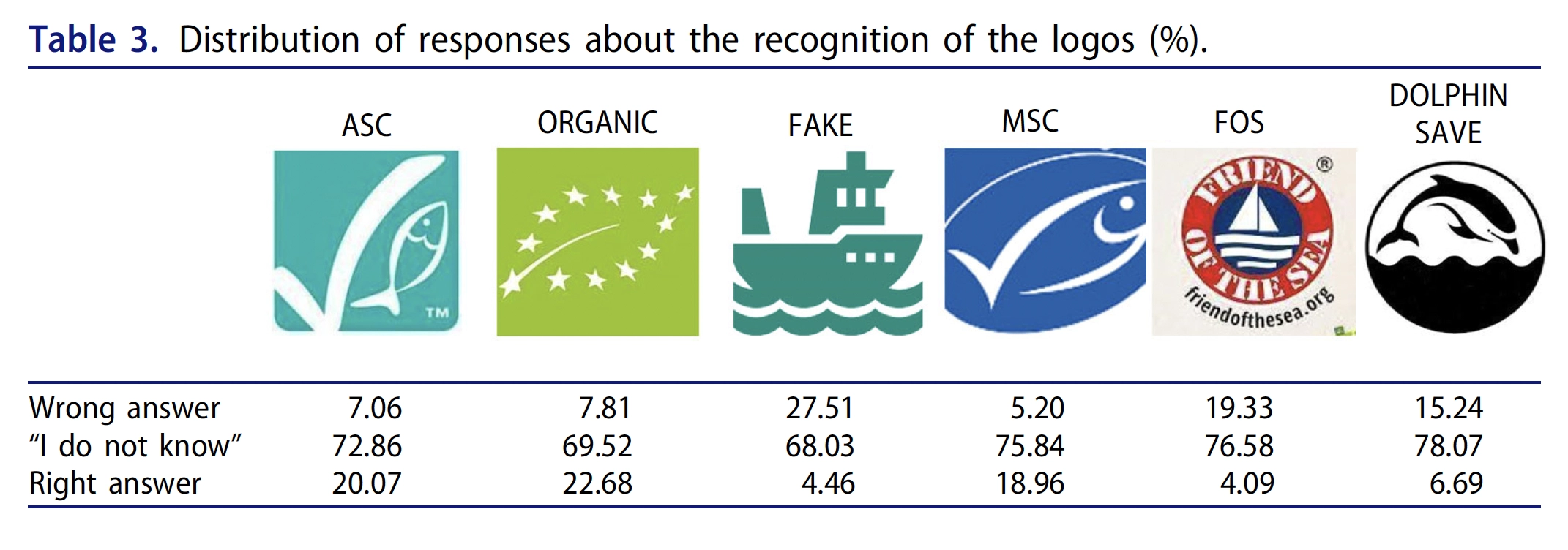
Aim of visuals: Eco-labeled fish logos. Five true logos and one fake.
People: Italy, tuna fish: 289 participants.
Method: Web-based survey.
Effect of visuals: Most of the respondents were unable to identify the logos.
Suggestions for design: None.
Suggestions for policy: The results ‘solicits reflections for firms and policy makers on the importance of recognizability of labels from the point of view of attracting potential sustainable consumers.
Comment: Use of Likert scales in questionnaire. For example: A question about the level of trust toward eco-labels (5-point scale, from “not at all” to “very much”). There are many eco-labels and it is unlikely that they are all equally trustable.
Nakaishi T, Chapman A. (2024) ‘Eco-labels as a communication and policy tool: A comprehensive review of academic literature and global label initiatives’. Renewable and Sustainable Energy Reviews. 202, 114708. [DOI].
Aim of visuals: ‘To facilitate communication between producers and consumers and to promote environmental and social policies.’
Method: Literature review of 16 articles + a trend study of the Ecolabel Index focusing on certification.
Effect of visuals: ‘At this time there is limited evidence that eco-labels can serve as effective communication and policy tools. There also remain significant improvement opportunities for many label programs to realize their potential.’
Suggestions for design: None.
Suggestions for policy: The importance of post-certification audit systems and stricter label standards
Comment: The article does not contain any illustrations. It is unclear which eco-labels the authors discuss. They suggest ‘a unified, trustworthy, easily understood communication regime.’ without recommendations on how to achieve this.
Darnall N, Ji H, Potoski M. (2017) ‘Institutional design of ecolabels: Sponsorship signals rule strength’. Regulation & Governance. 11, 438–450. [DOI].
Aim of visuals: to help consumers identify environmentally superior products and services
Method: Investigation of 189 prominent eco labels.
Effect of visuals: Most eco labels have basic rules for environmental performance, monitoring, and conformance, the strength of these rules varies across labels according to sponsoring organization.
Suggestions for design: Well-designed eco labels can play a positive role in environmental governance, particularly in an era in which government action has been sluggish, both on a global scale and within many countries.
Suggestions for policy: At present, 37 percent of independent sponsors and 61 percent of government sponsors fail to provide institutional rules about their ecolabels.
Comment: It is not clear what is meant by ‘well-designed eco-labels’. And it is essential to make the rules for a label available.
Horne RE. (2009) ‘Limits to labels: The role of eco-labels in the assessment of product sustainability and routes to sustainable consumption’. International Journal of Consumer Studies. 33, 175–182. [DOI].
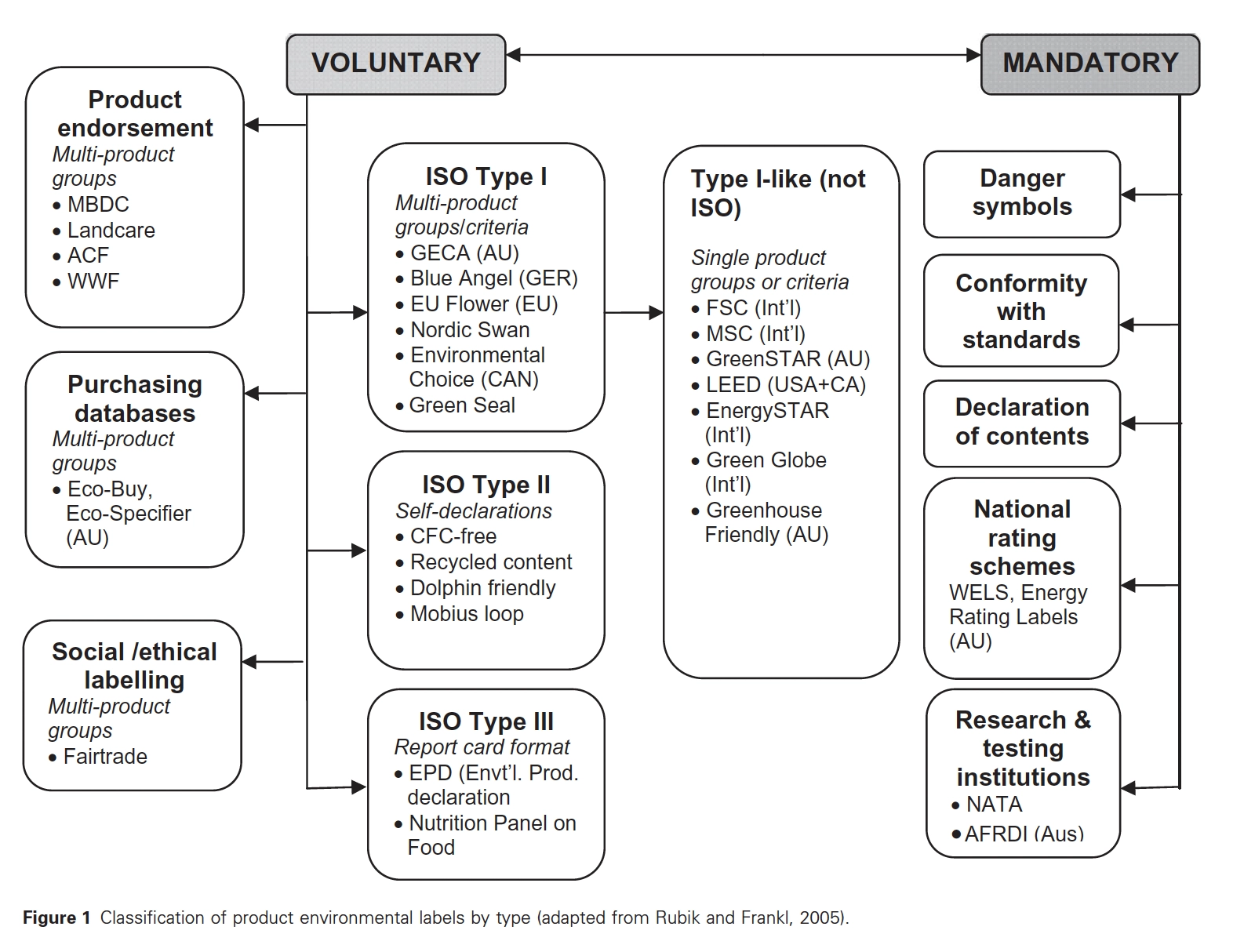
Aim of visuals: The assumption is that if consumers are presented with appropriate label information their purchases will change and more sustainable purchasing will result.
Method: An analysis of 36 labelling schemes.
Effect of visuals: Mandatory/voluntary? Independent certification? It is clear that eco-labels can affect consumer choice although it is less clear whether this leads to reduced environmental impacts.
Suggestions for design: The reality often is too many products, too much information, too little time, and a paucity of independent, accessible, readily accessible and understandable information about environmental performance.
Suggestions for policy: Eco-labels are not enough, and the role of government in both legislation setting and strategy and goal setting is critical.
Comment: The visuals are not included, only descriptions. It is not clear - for example - what ‘green seal’ or ‘Recycled content’ exactly refer to.
Gorton M, Tocco B, Yeh C-H, Hartmann M. (2021) ‘What determines consumers’ use of eco-labels? Taking a close look at label trust ’. Ecological Economics. 189, 107173. [DOI].
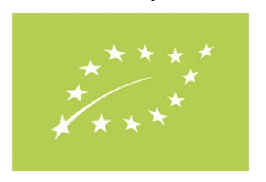

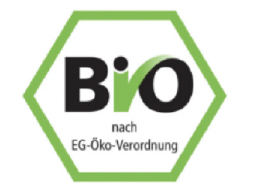

Aim of visuals: eco-labels operate as an informational cue regarding a product’s environmental characteristics,
People: 5688 individuals across 7 European Countries: (France, Germany, Hungary, Italy, Norway, Serbia and the UK).
Method: Online survey, Likert scales
Effect of visuals: Page 8: ‘our findings reveal a disappointing picture.’ The analysis reveals that the effect of institutional trust on use of an eco-label is mediated by trust in that eco-label.
Suggestions for design:
Suggestions for policy: The results suggest that for eco-label managers wishing to increase consumer uptake of their labels, communicating third-party verification as is a critically important informational cue for enhancing consumer trust.
Comment: Table one indicates ‘participants recognizing the EU Organic label’, but it does not mention the percentages per country. They vary between 16,1% (UK) to 55% (France). After 11 years ... recognition is low. Likert scale do not indicate comprehension.
Gonzalez-Torres M, Bertoldi P, Castellazzi L, Perez-Lombard L. (2023) ‘Review of EU product energy efficiency policies: What have we achieved in 40 years?’. Journal of Cleaner Production. 421, 138442. [DOI].
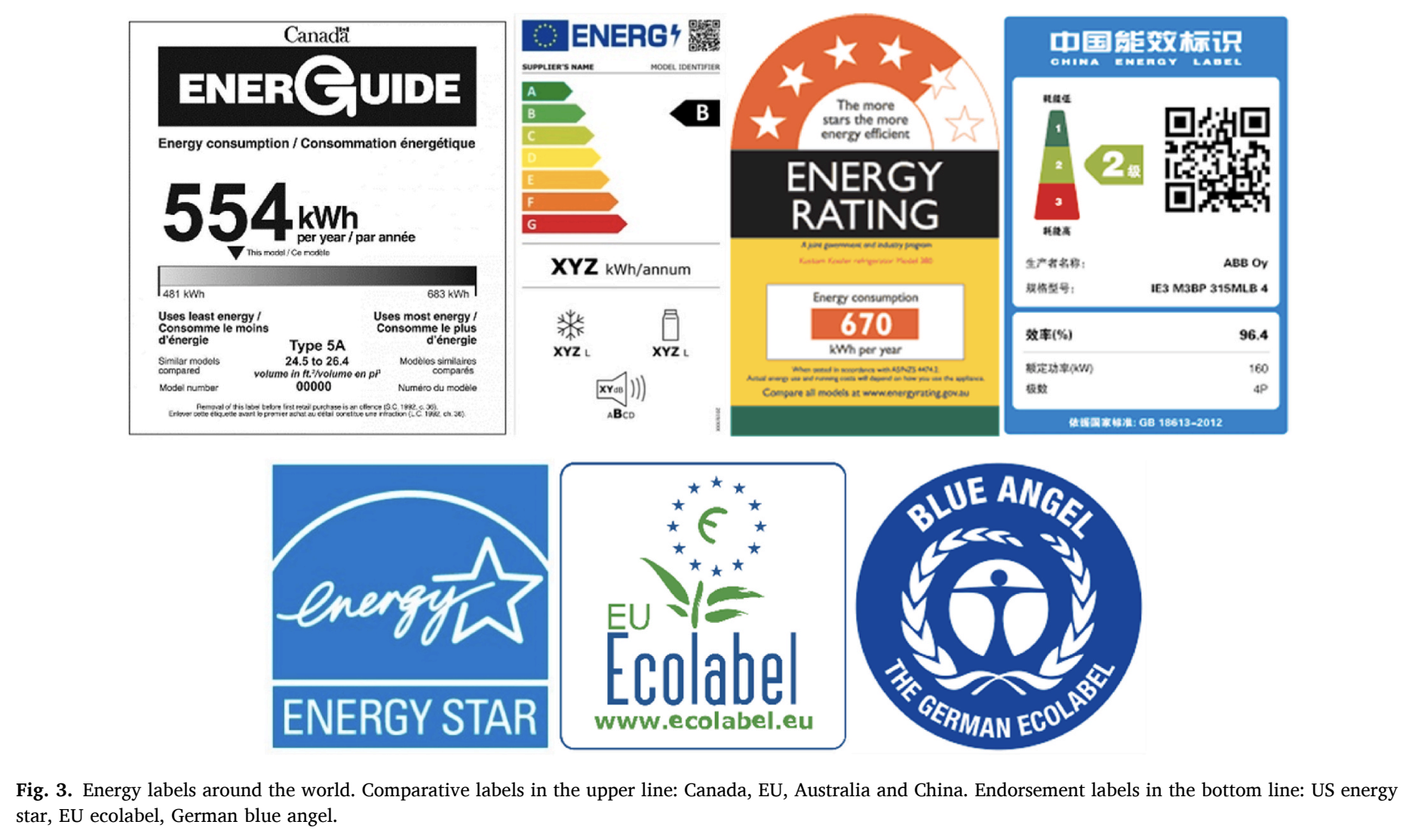
Aim of visuals: The information in the energy labels varies.
Method: Literature review.
Effect of visuals: Energy labels have been sometimes shown to lack clarity. For instance, a consumer study in 2016 found that less than one third of the respondents could understand all the information provided on the heaters energy label.
Suggestions for design: The energy labels design have to be eye-catching, highlighting the energy efficiency class with a clear colour code from green (most efficient) to red (least efficient) to ease models comparisons. They need to be uniform and simple, so that consumers can easily understand them, but accurate, so they can be trusted and provide all the necessary information.
Suggestions for policy: One of the suggestions is: ‘the response of consumers to energy labels should be periodically revised to identify and solve barriers, such as the misleading categories or the misunderstandings between energy savings and energy efficiency.’
Comment: The design criteria ‘uniform and simple’ is very hard to achieve in practice. Same article mentions: ‘This led to the coexistence of both scales and was misleading for consumers.’ which proves this point, but also that it is very hard to achieve.’
Yokessa M, Marette S. (2019) ‘A Review of Eco-labels and their Economic Impact’. International Review of Environmental and Resource Economics. 13, 119–163. [DOI].
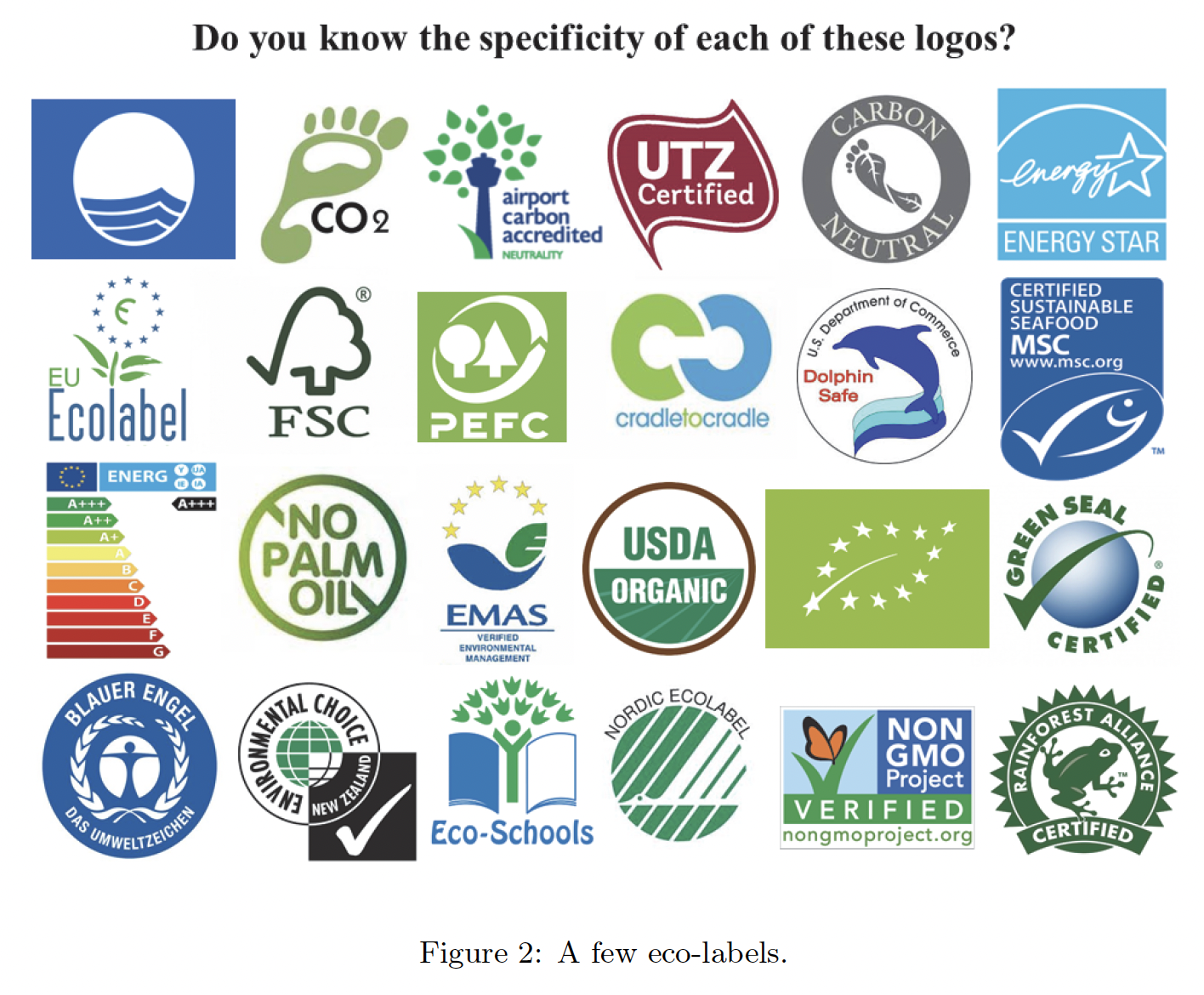
Aim of visuals: Labels distinguish products according to environmental criteria or declarations providing quantitative indicators of environmental performance.
People: This review questions the efficiency of eco-labeling.
Method: Literature review and discussion of empirical examples.
Effect of visuals: Both the complexity and the proliferation of eco-labels are likely to hamper their efficiency in guiding consumers. It underlines the limitations of eco-labels for conveying complex information to consumers.
Suggestions for design:
Suggestions for policy: From a regulatory perspective, several studies show that eco-labels are useful, but they cannot be considered a panacea for improving environmental quality. A government may encourage the creation of global environmental labels encompassing several attributes or it may limit the number of eco-labels for a given attribute.
Comment: Detailed review. Odd to look at economic impact, and not on ecological impact? Does this miss the point?
Duist L van, Gijsbers L. (2022) ‘Invloed van duurzaamheidskeurmerken op vertrouwen, vergelijkbaarheid en begrip’ (‘Influence of sustainability labels on trust, comparability and understanding’). Amsterdam: Autoriteit Consument en Markt. [PDF] (Report in Dutch).
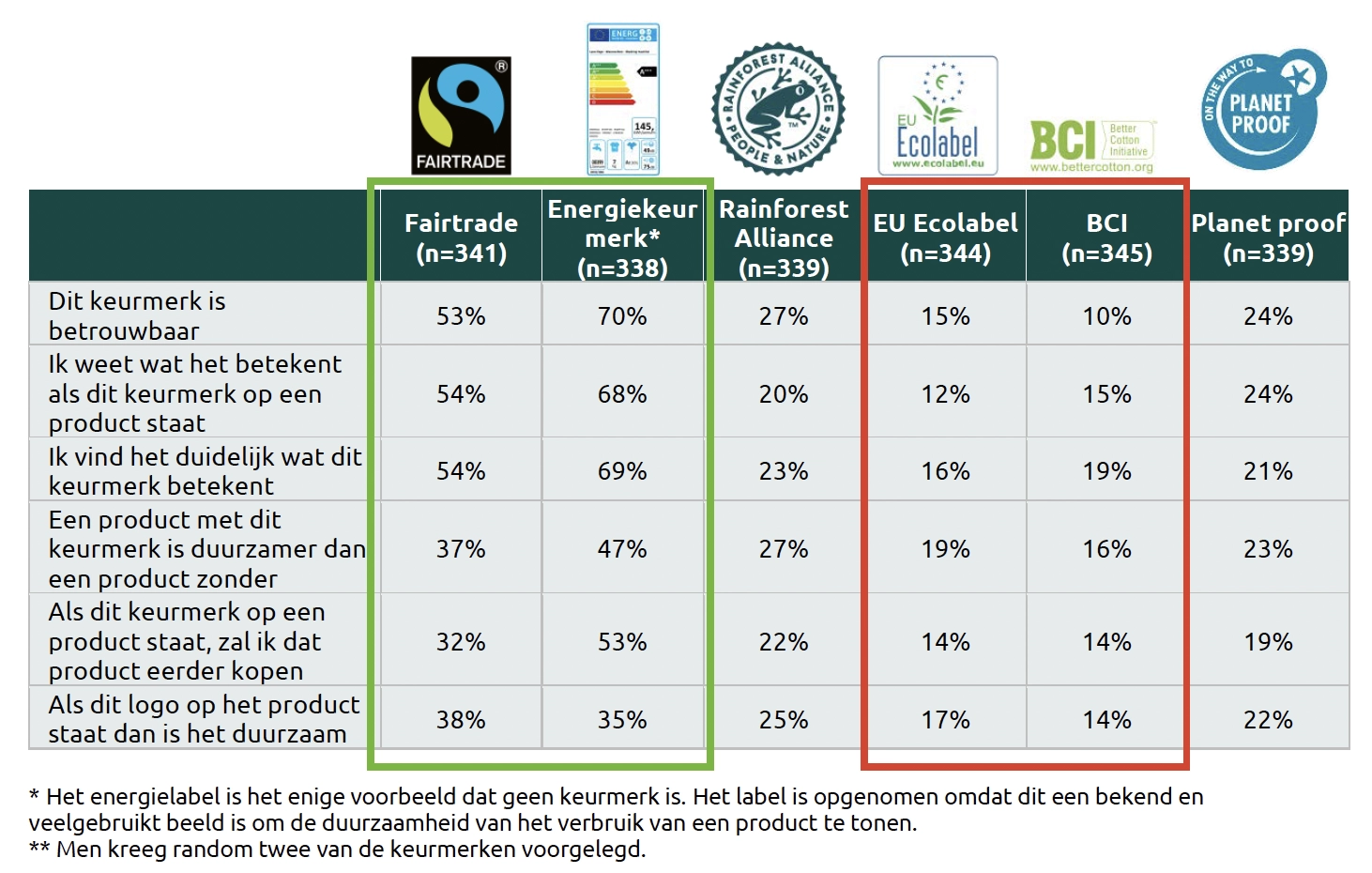
Aim of visuals: ‘duurzaamheidskeurmerken’ (sustainability labels)
People: The Netherlands. 1023 participants.
Method: Quantitative online research.
Effect of visuals: 70% cannot name a single sustainability label. The Fairtrade and Energy-labels score high on trust, comparability, and understanding. The EU-Ecolabel and BCI score lower.
Suggestions for design: The proliferation of eco-labels leads to blurred signals. Consumers might be confused as they do not know the specificity of each eco-label.
Suggestions for policy: Page 21: ‘In summary, the Dutch expect to benefit most from stricter government regulations (68%) and an explanation of who checks the quality mark (63%).’
Comment: Knowledge about sustainability quality marks is remarkably limited. Even the highest scoring labels indicate fairly severe issues. 30% of the 1023 participants indicate that they do not trust the Engergy-label.
Thøgersen J, Haugaard P, Olesen A. (2010) ‘Consumer responses to ecolabels’. European Journal of Marketing. 44(11/12), 1787-1810. [DOI].
Aim of visuals: Sustainable seafood.
People: Denmark, 439 participants
Method: Mall-intercept survey
Effect of visuals: The MSC label helps the consumer achieve the goal of buying sustainable fish products and it thereby fulfil needs reflected in environmental concern.
Suggestions for design: -
Suggestions for policy: the communication strategy will need to change over time. Change focus and target more reluctant adopters, which means consumers with less issue-relevant knowledge and/or less motivation.
Comment: This article proposes a framework for understanding consumer responses to ecolabelling. A balance between ‘past experiences’ that reduce the effort perhaps because they have developed a mental script for how to act when learning about a new ecolabel. Alas, test materials were not included: hard to evaluate this study.
Goossens Y, Berrens P, Charleer L, Coremans P, Houbrechts M, Vervaet C, Tavernier J de, Geeraerd A. (2017) ‘Qualitative assessment of eco-labels on fresh produce in Flanders (Belgium) highlights a potential intentioneperformance gap for the supply chain’. Journal of Cleaner Production. 140, 986e995. [DOI].
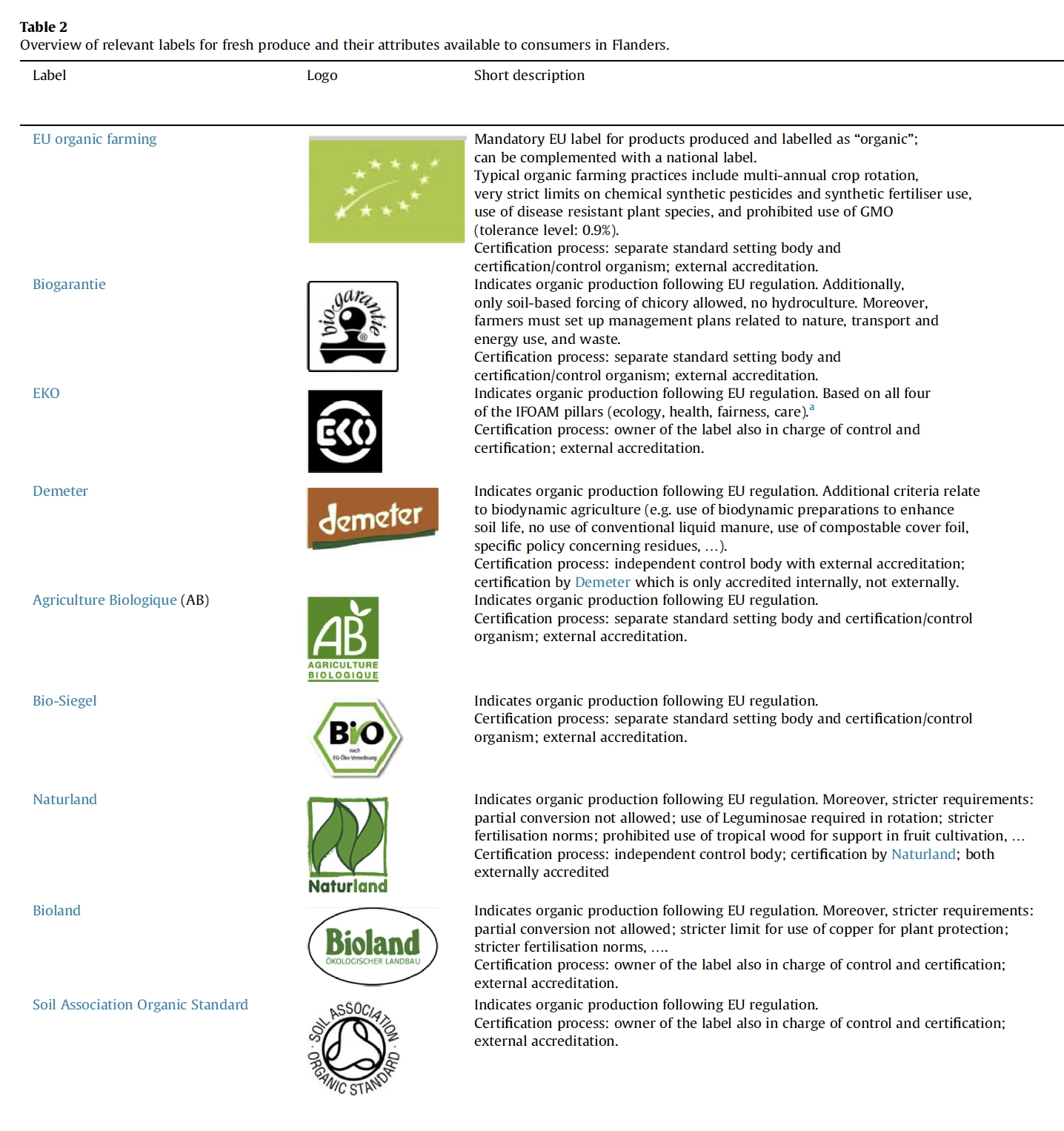
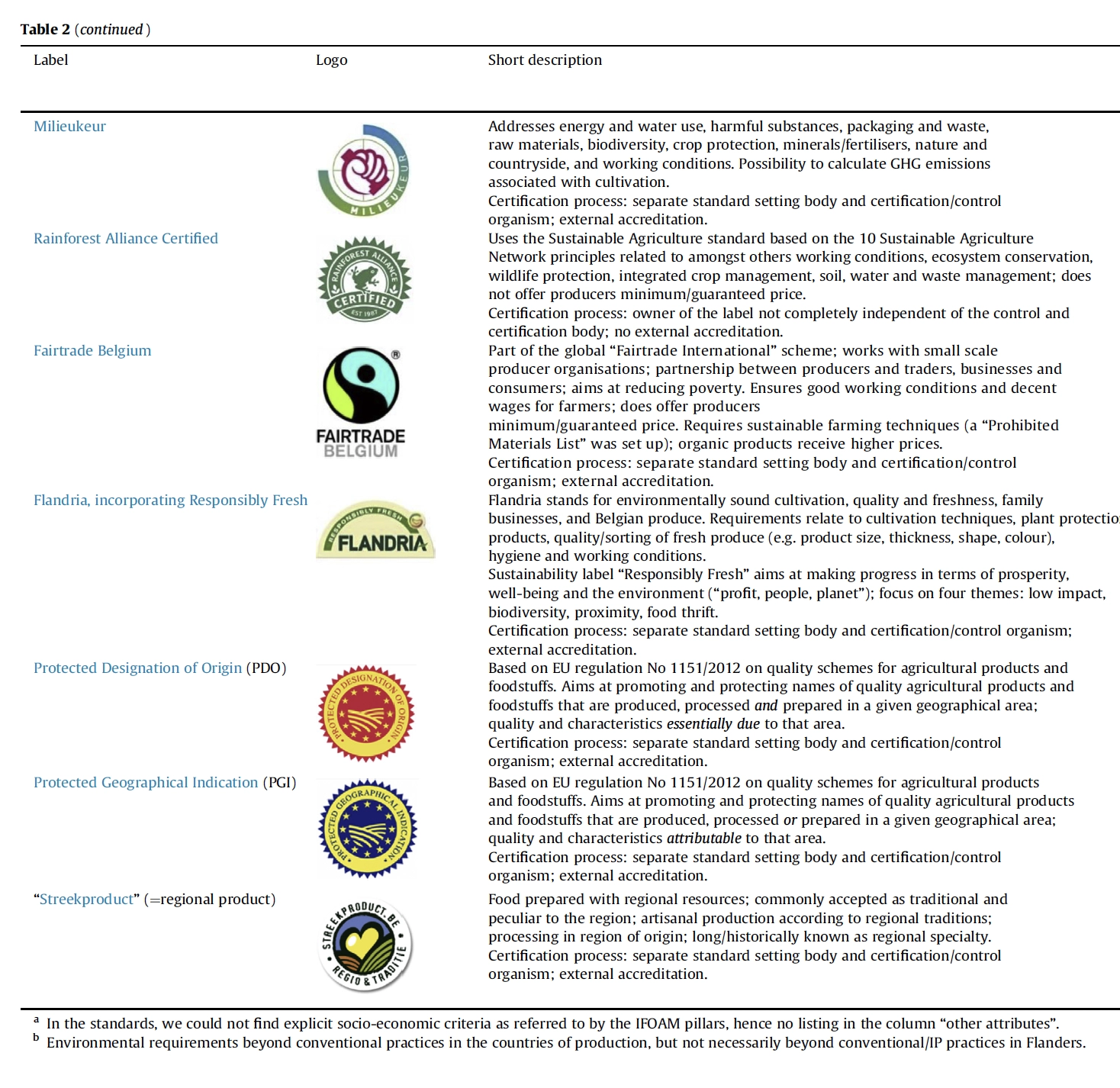
Aim of visuals: The existing labelling landscape fails at enabling consumers to make adequate decisions for purchasing environmentally sound food.
People: 553 Belgian participants.
Method: Online questionnaire.
Effect of visuals: we conclude that the current food labels found on fresh produce in Flanders fail at giving the consumer an adequate indication of the environmental friendliness of the products for sale.
Suggestions for design: We conclude that performance-based labels, covering the entire food chain of fresh produce, using the life cycle assessment approach (LCA) and including situational parameters such as time of consumption, origin and production and distribution mode, are indispensable. However, developing a whole range of new labels is no option as the proliferation of eco-labels has already brought consumers into a state of confusion.
Suggestions for policy: (i) harmonisation of the information provided to consumers, as is being aimed at through the EU Product Environmental Footprint project, and (ii) improvement of this information, in terms of including dynamic aspects
Comment: The need for ‘performance based labels’ is interesting, but the suggestion not to develop a range of new labels is in stark conflict with that. The difference between the ‘EU organic farming label’ and the ‘eco label’ remains vague.
Ihemezie EJ, Ukwuaba IC, Nnaji AP. (2018) ‘Impact of ‘Green’ Product Label Standards on Consumer Behaviour: A Systematic Review Analysis’. International Journal of Academic Research in Business and Social Sciences. 8(9), 666–684. [DOI].
A systematic review 18 studies about environmental labels. No illustrations: not clear if these ecolabels can be directly compared. 4 of the articles focused on the food industry, 3 on sea products, 3 on energy and electrical appliances such as washing machines, 2 on forest products, 1 on textile and apparel industry, 1 on building, 1 on personal care products such as laundry detergents, while the rest are on general products.