 | |
| Compiled by: Karel van der Waarde 2024 | |
| | |
| |
| | |
| Colofon & notes | |
|
|
Material indicators: Plastics
There are several symbols that indicate the resins of plastics. Initially, these were numbered 1 to 7 and put insided the Möbius triangle. This was later modified to a triangle. [There is no relation with the ‘triangular warning traffic sign’.
The European Union has introduced a ‘single-use’ plastic markings for Sanitary towels, wet wipes, tobacco filters, and coffee cups.

Roy D, Berry E, Dempster M. (2022) ‘“If it is not made easy for me, I will just not bother”. A qualitative exploration of the barriers and facilitators to recycling plastics’. PLoS ONE. 17(5), e0267284. [DOI].
Aim of visuals: Make the process of recycling less tedious, confusing, and more habitual.
People: Northern Ireland
Method: 18 semi-structured interviews, 756 adults in online survey.
Effect of visuals: Visual cues on product packing and recycling resources can address ambiguity about which plastic materials can/ cannot be recycled and increasing opportunities to recycle (via consistent availability of
recycling bins) can reduce the physical burden of accessing recycling resources.
Suggestions for design: ‘Visual cues in current designs add to confusion’. The triangle symbol in general causes confusion, only two respondents understood its function.
Suggestions for policy: Participants reported that existing labels are unhelpful and can only add to confusion. They prefer clear, unambiguous labels and colour coding was also suggested. Colour coding of bins was also suggested.
Comment: The three conclusions on page 16 (1. Plastic packaging should have visual, unambiguous cues about whether it can be recycled. 2. colour code bins. 3. increasing motivation to recycle.) show that ‘householders who simply do not want to be faced with uncertainty and confusion when trying to perform what, to them, should be made an automatic, effortless behaviour.’
Shamsuyeva M, Edres H-J. (2021) ‘Plastics in the context of the circular economy and sustainable plastics recycling: Comprehensive review on research development, standardization and market’. Composites Part C: Open Access. 6, 100168. [DOI].
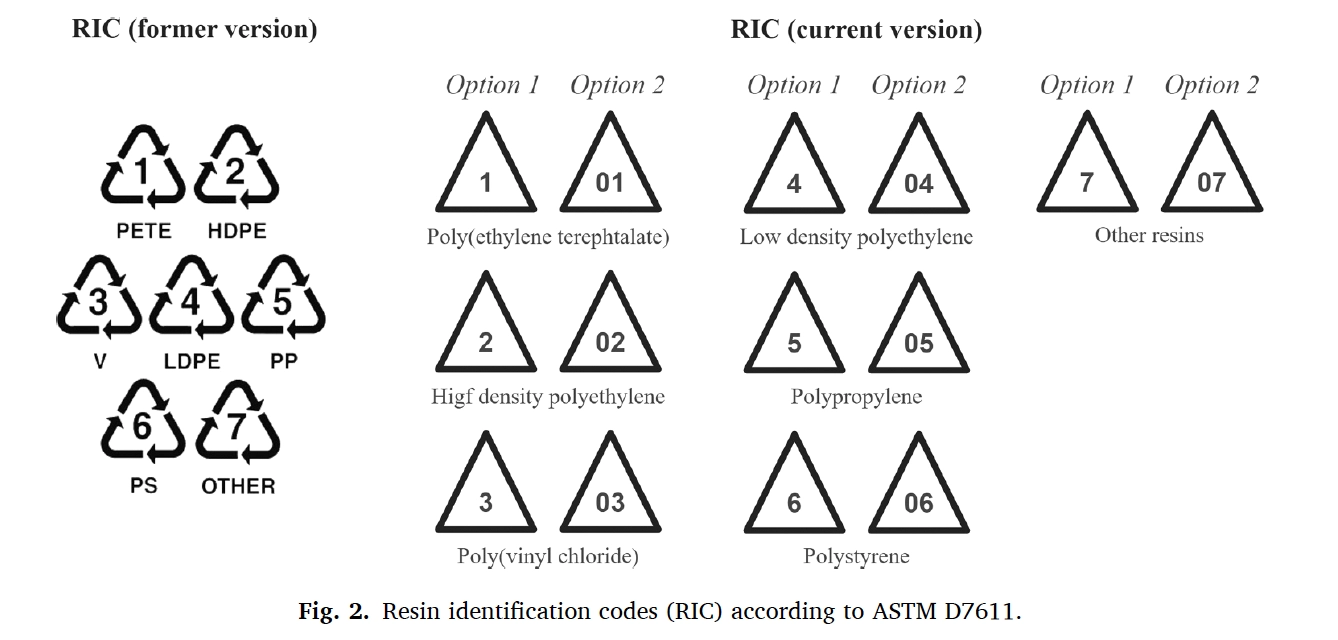
Aim of visuals: to facilitate recycling of post-consumer plastic waste. (In 2013 the RIC symbols were updated to a solid equilateral triangle to eliminate the consumer confusion about recyclability. However, the former version is still commonly used in the industry.)
People: -
Method: -
Effect of visuals: As a result, the diversity and complexity, especially if several symbols are used simultaneously, leads to confusion by consumers.
Suggestions for design: The use of the certified recycling labels is very important, in order to ensure transparency along the entire supply chain.
Suggestions for policy: -
Comment: This is not a ‘global system’. For example, according to the Chinese system the
number 20 refers to the cellulose nitrate and according to the EU system to the corrugated fibreboard.
Burrows SD, Ribeiro F, O’Brien S, Okoffo E, Toapanta T, Charlton N, Kaserzon S, Lin C_Y, Tang C, Rauert C, Wang X, Shimko K, O’Brien J, Townsend PA, Grayson MN, Galloway T, Thomas KV. (2022) ‘The message on the bottle: Rethinking plastic labelling to better encourage sustainable use’. Environmental Science & Policy. 132, 109-118. [DOI].
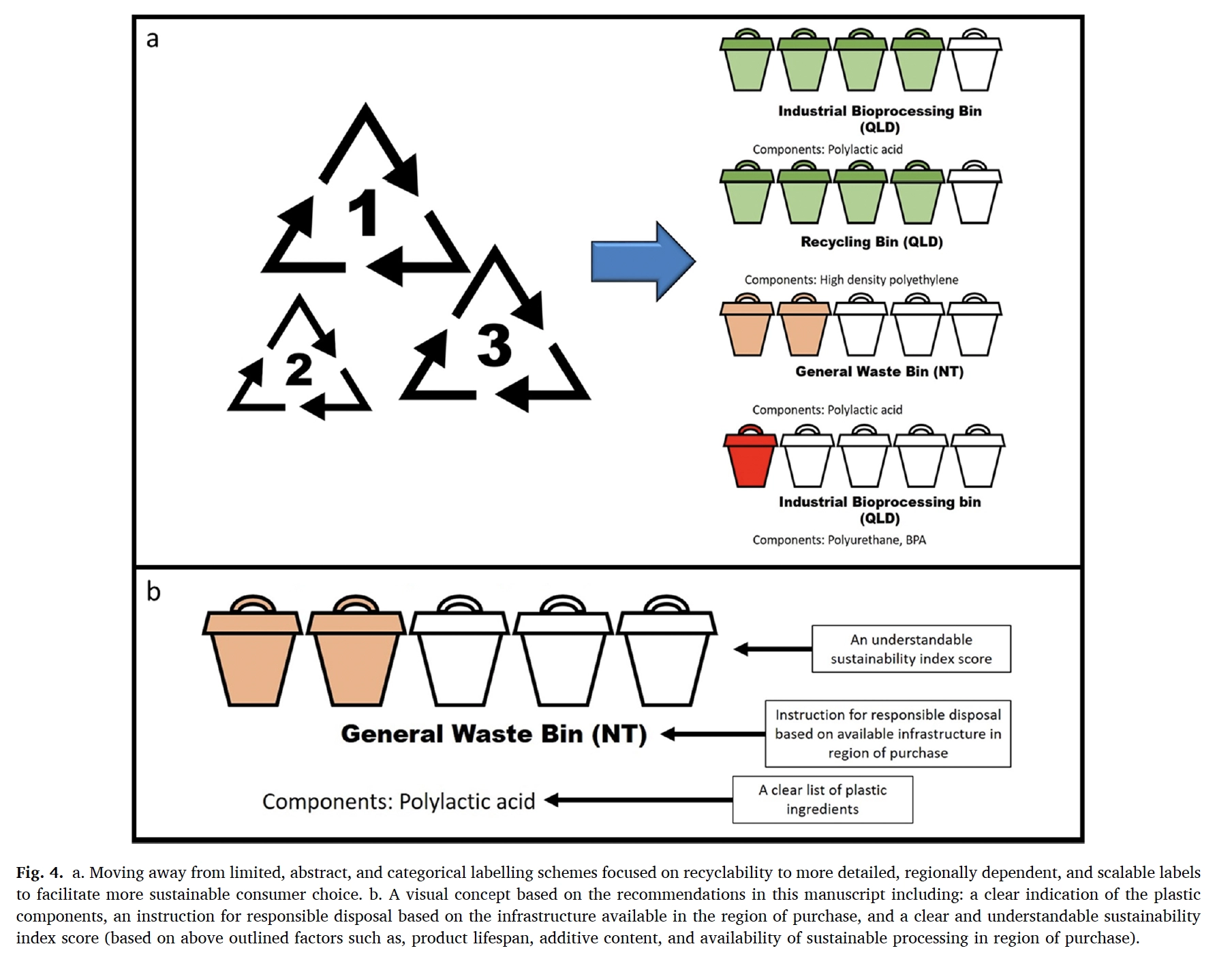
Aim of visuals: Plastic labelling must change to contribute to a holistic intervention on global plastic mismanagement.
People: -
Method: Reviewing literature.
Effect of visuals: The issue of plastic waste is more complex than indicated by contemporary labelling schemes.
Suggestions for design: Plastic labels can falsely indicate a product is recyclable, for example through the use of the International Plastic Resin Symbols, The Mobius Loop from the UK and The Green Dot from the EU
Suggestions for policy: Three key recommendations: 1. An accurate and clear “sustainability scale” to empower consumers to make decisions informed by environmental and human health implications; 2. Directions for appropriate disposal action in the region of purchase; 3. A comprehensive list of plastic composition, including additives.
Comment: Good arguments: ‘The onus to understand complex, technical, and sometimes misleading disposal processes and product attributes is placing an unreasonable expectation and burden on consumers’
Pellegrini L, Maltoni D, Graffieti G, Lomonaco V, Mazzini L,Mondardini M, Zappoli M. (2023) ‘A weakly supervised approach for recycling code recognition’. Expert Systems With Applications. 215, 119282. [DOI].
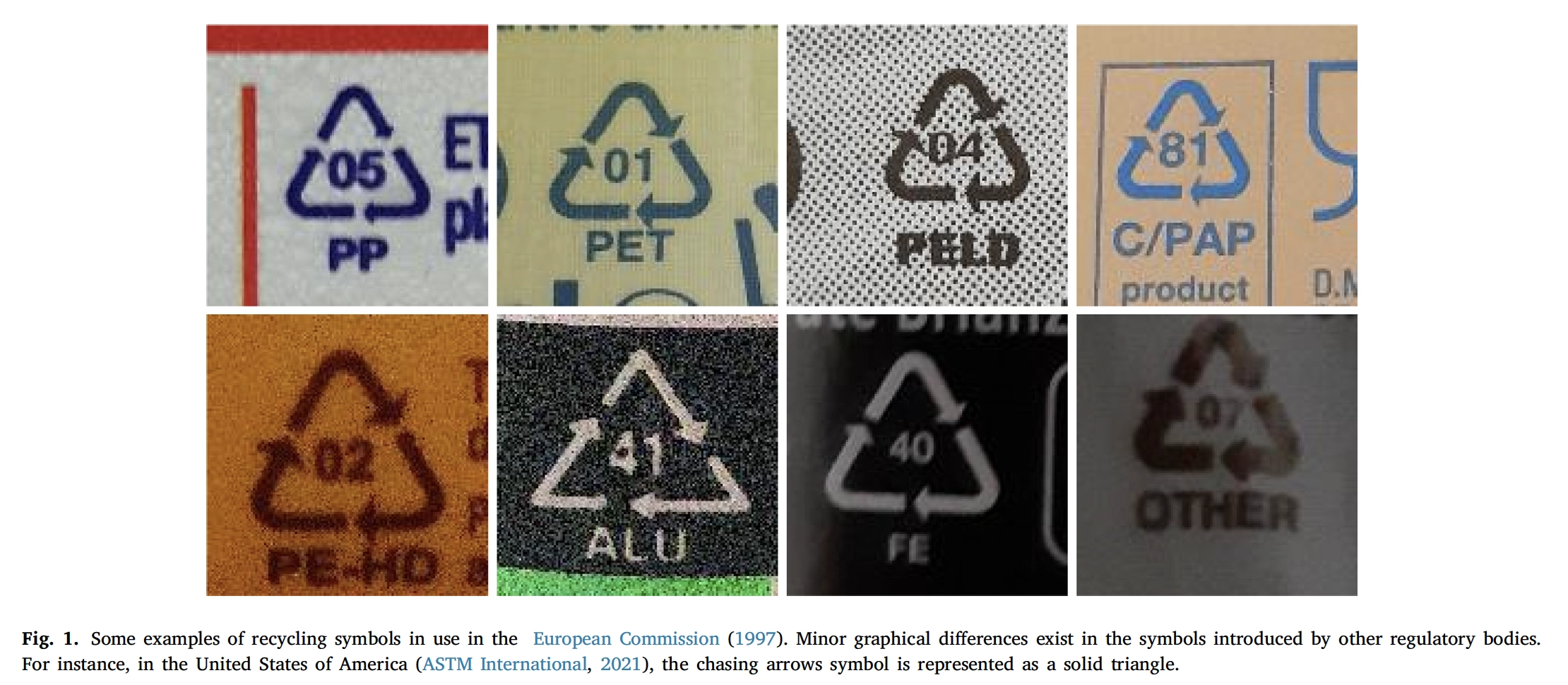
Aim of visuals: Identify materials (resin identification marker/code). An extensive collection of photographs was made by Piao Ya in 2020.
People: No. Automatic detection of symbols.
Method: Optical character recognition.
Effect of visuals: Unfortunately, the large number of recycling codes printed on products makes this process unfriendly for many users. Focusing on recycling codes rather than object visual aspects, blends together
state-of-the-art deep learning detection techniques as well as ordinary image processing pipelines and tools.
Suggestions for design: -
Suggestions for policy: -
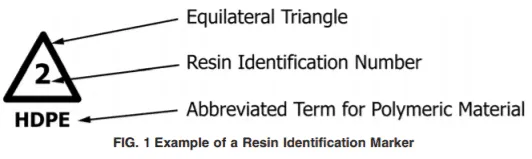
Comment: It seems to be possible to detect the symbols through optical recognition. This might need to be explored further. [Note: these symbols are poorly understood by consumers. That was not the intention. In the US, the three arrows have been replaced in 2019 by a solid triangle-outline (ASTM D7611)]. These symbols are only for the identification of plastics.