 | |
| Compiled by: Karel van der Waarde 2024 | |
| | |
| |
| | |
| Colofon & notes | |
|
|
Energy labels
The label for electric energy consumption is described in article 4 of directive 2010/30/EU on the indication by labelling and standard product information of the consumption of energy and other resources by energy-related products. An explanation of the Energy label is provided on a website of the European Union on ‘Ecodesign and Energy Label’ The label was introduced in 1992 and updated in 2009 and in 2021. The explanation also contains several examples for different groups of household appliances.

Stadelmann M, Schubert R. (2018) ‘How Do Different Designs of Energy Labels Influence Purchases of Household Appliances? A Field Study in Switzerland’. Ecological Economics. 144, 112-123. [DOI].
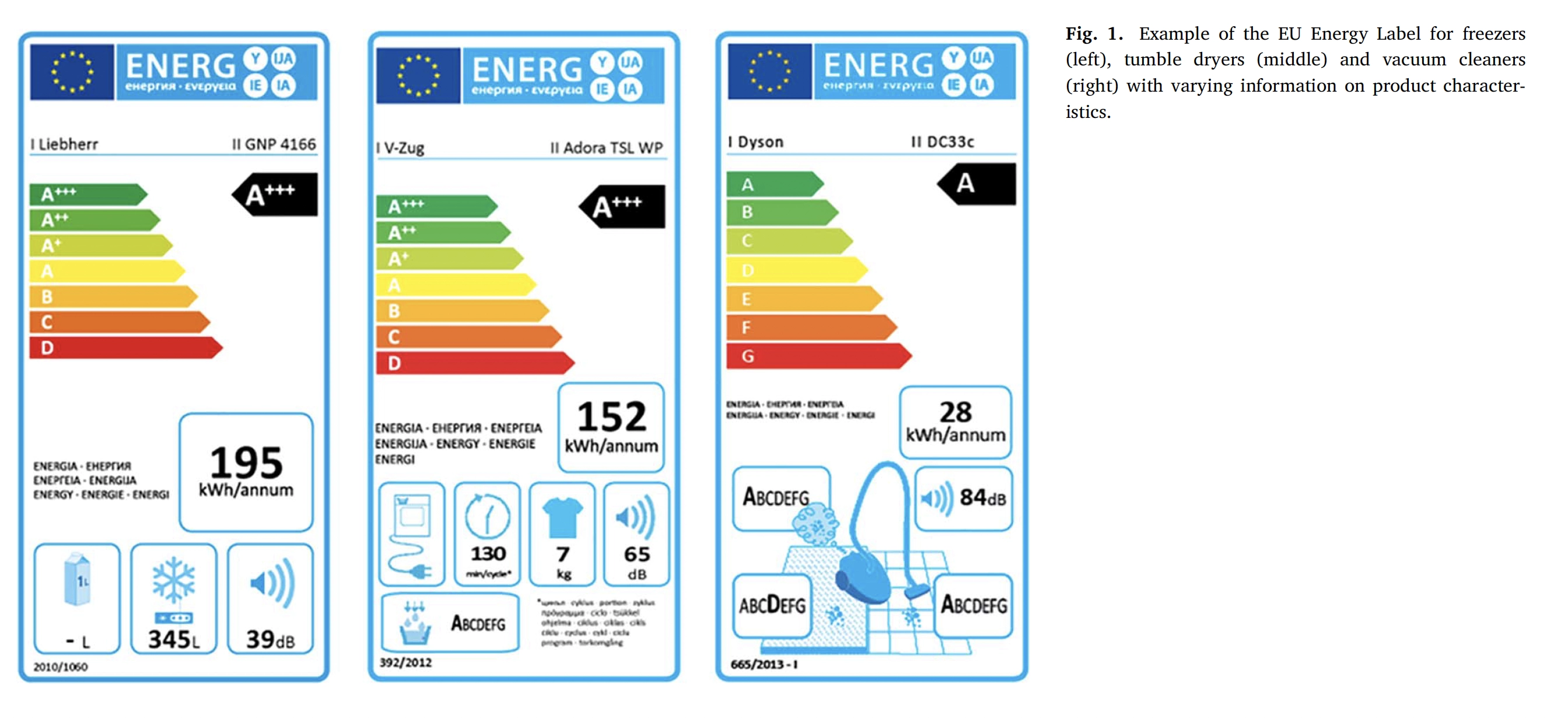
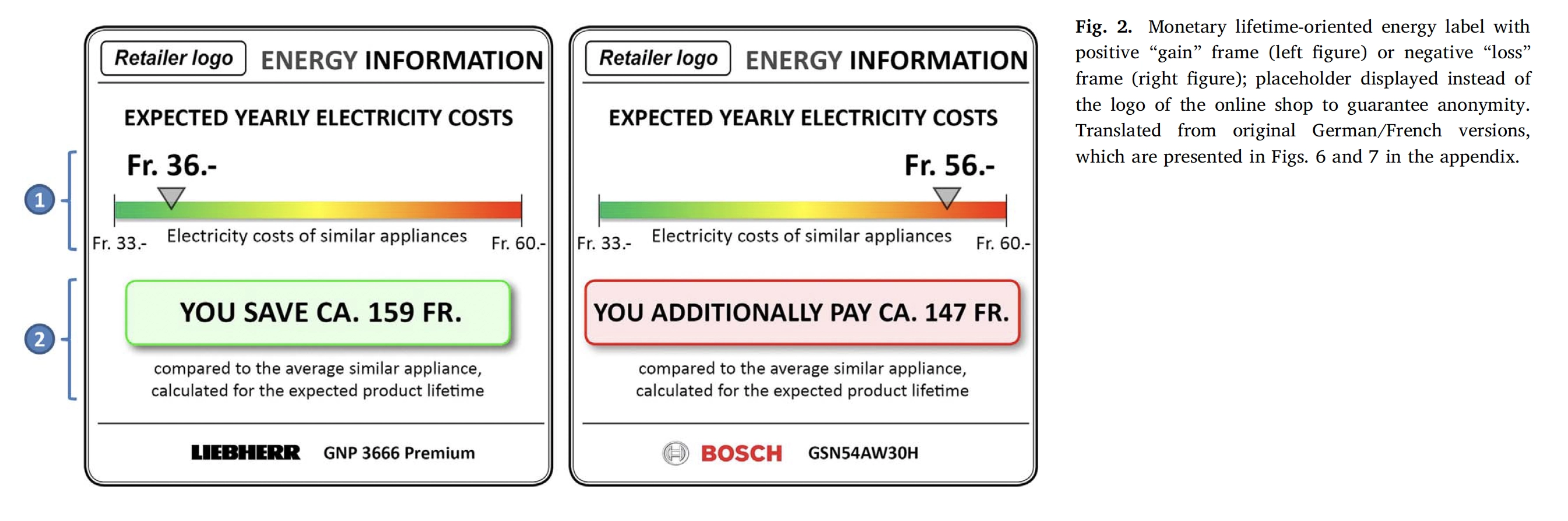
Aim of visuals: Energy labels provide information on appliances’ energy consumption and aim at increasing consumers’ attention to this characteristic.
People: 837 Swiss consumers, 180 filled in questionnaire.
Method: Swiss online retailer. Two labels (EU and own design) were shown for 4 weeks and replaced (3 times). What is effect on purchases? + Questionnaire.
Effect of visuals: The label with monetary and lifetime-oriented information does not lead to a
larger reduction in mean expected electricity consumption than the EU Energy Label.
Suggestions for design: There is a description of the design of the ‘Monetary Lifetime-oriented Energy Label’ on page 115-116. Page 120: ‘It seems that the design of an energy label, for instance the type of rating scale or
the salience of different pieces of information on the label, is of high relevance.’
Suggestions for policy: Our results confirm that consumers pay attention to the energy efficiency
class of the EU Energy Label.
Akker K van den, Elsen M. (2023) ‘Consumer study on the effects of the presence and location of the energy label in online shopping environments in Europe’. [Research done for CLASP.] Tilburg: Centerdata. [PDF on clasp website].
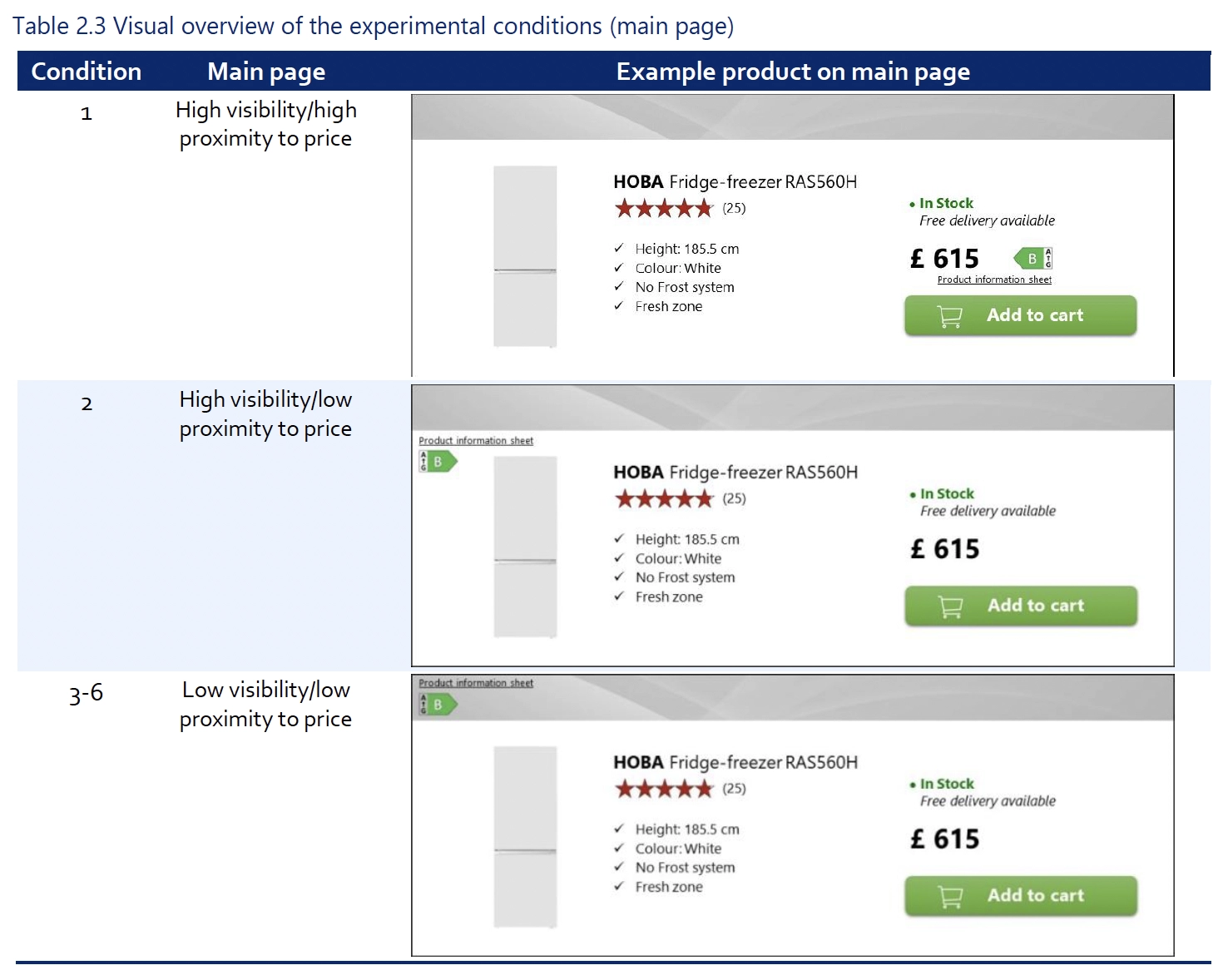
Aim of visuals: The impact of online energy labeling on consumer choices for household appliances in Europe.
People: 4897 participants
Method: Online experiment in 4 countries: UK, Italy, Sweden and Poland. Half on mobile phone, half on web.
Effect of visuals: Conclusion: ‘the provision (vs. not) of an energy label on different pages in a webstore can have marked effects on the energy efficiency of consumer choices’ and ‘the exact position of the (nested) energy label and the device type that is used have much more limited effects, if any.’
Suggestions for design: None.
Suggestions for policy: Results are as expected for CLASP: energy labels are effective when they are available. Design doesn’t matter.
Comment: The three test conditions, and the energy information are unrealistic: the ‘redesign’ of the label and the location in conditions 2 to 6 are both poorly designed. The results are not comparable with studies into standard energy labels because the designs are very different. Only about a quarter of the respondents chose the most efficient product?
Andor MA, Gerster A, Götte L. (2019) ‘How effective is the European Union energy label? Evidence from a real-stakes experiment’. Environmental Research Letterts. 14(4), 044001. [DOI].
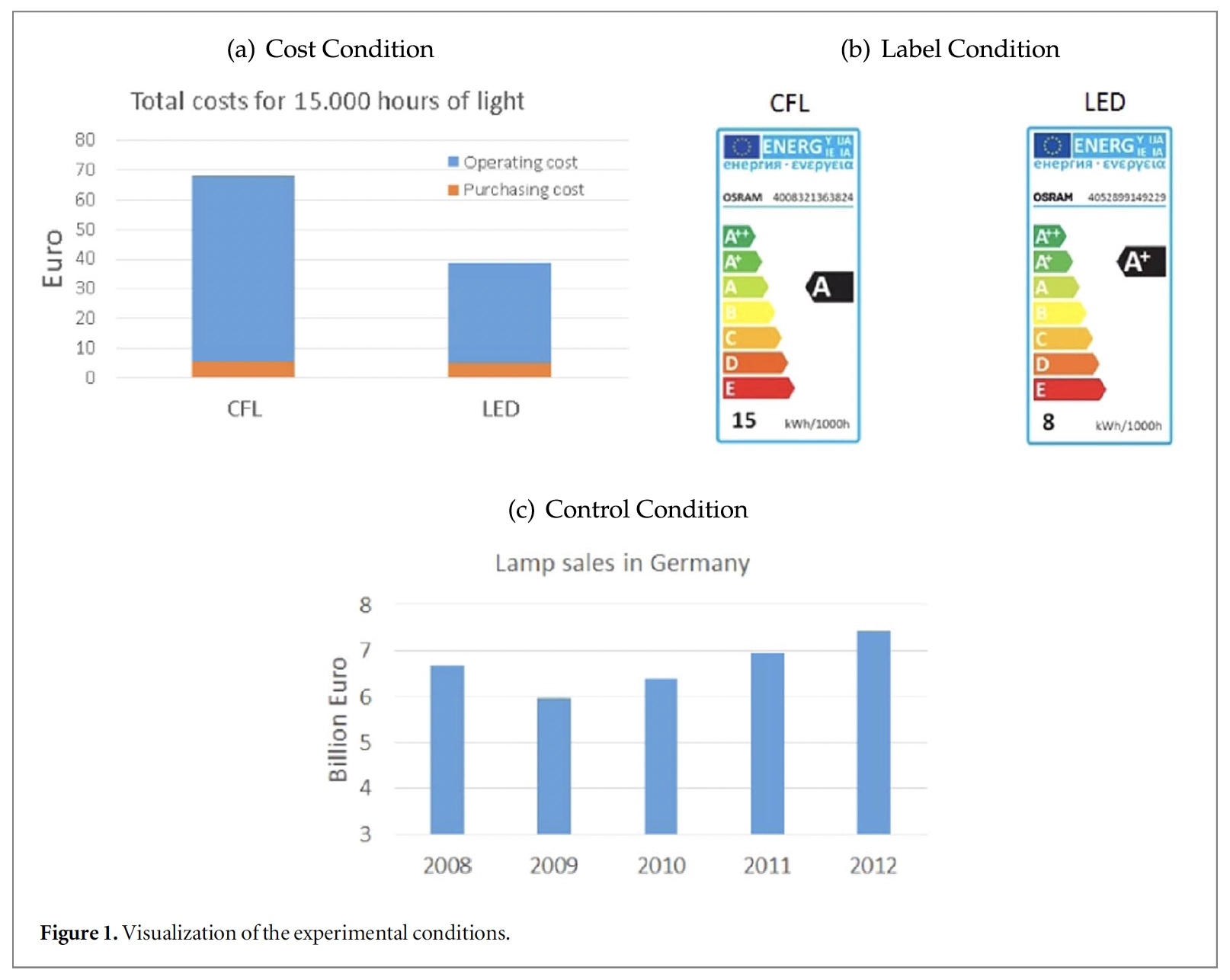
Aim of visuals: Comparing: ‘the current EU label, which presents gradelike efficiency classes, and an intervention that informs participants about the total lifetime-cost savings that arise from more energy-efficient purchases.’
People: Germany, 719 household heads.
Method: focuses on the light bulb market. Four step process: 1. inform about choice task. 2. fill out price lists. 3. Three conditions: different information about light bulbs. 4. Price comparison.
Effect of visuals: Our results show that the EUenergy label does not increase demand for energy-efficient
products over a control condition. Cost information is substantially more effective in increasing the WTP for
energy efficiency than the current EU energy label.
Suggestions for design: Energy labels could easily be amended to include operating cost estimates.
Suggestions for policy: -
Comment: The label was modified a few years after this study.
Beck M, Toulouse NÖ. (2023) ‘Assessing the impact of energy labels on attitude and behavioral intention: An empirical investigation’. Journal of Cleaner Production. 415, 137751. [DOI].
Aim of visuals: To understand the effects on attitude and behavioral intention by focusing on the transition phase in 2021 during which a juxtaposition of the old and new labels was implemented.
People: 994 French consumers
Method: questionnaire
Effect of visuals: The empirical findings first show the “double-edged” effect of the presence of labels by optimizing the ecological perception of the product, but also the perceived social risk.
Suggestions for design:
Suggestions for policy: they are of managerial interest as they emphasize the relevance for retailers of accompanying the customer in their comprehension and reading of this ecolabel; but also of political interest with a view to optimizing the effectiveness of the European measures taken within the ecological framework by insisting on
the importance of the juxtaposition of the old and new ELs.
Comment:
Waechter S, Süterlin B, Siegrist M. (2015) ‘The misleading effect of energy efficiency information on perceived energy friendliness of electric goods’. Journal of Cleaner Production. 93, 193-202. [DOI].
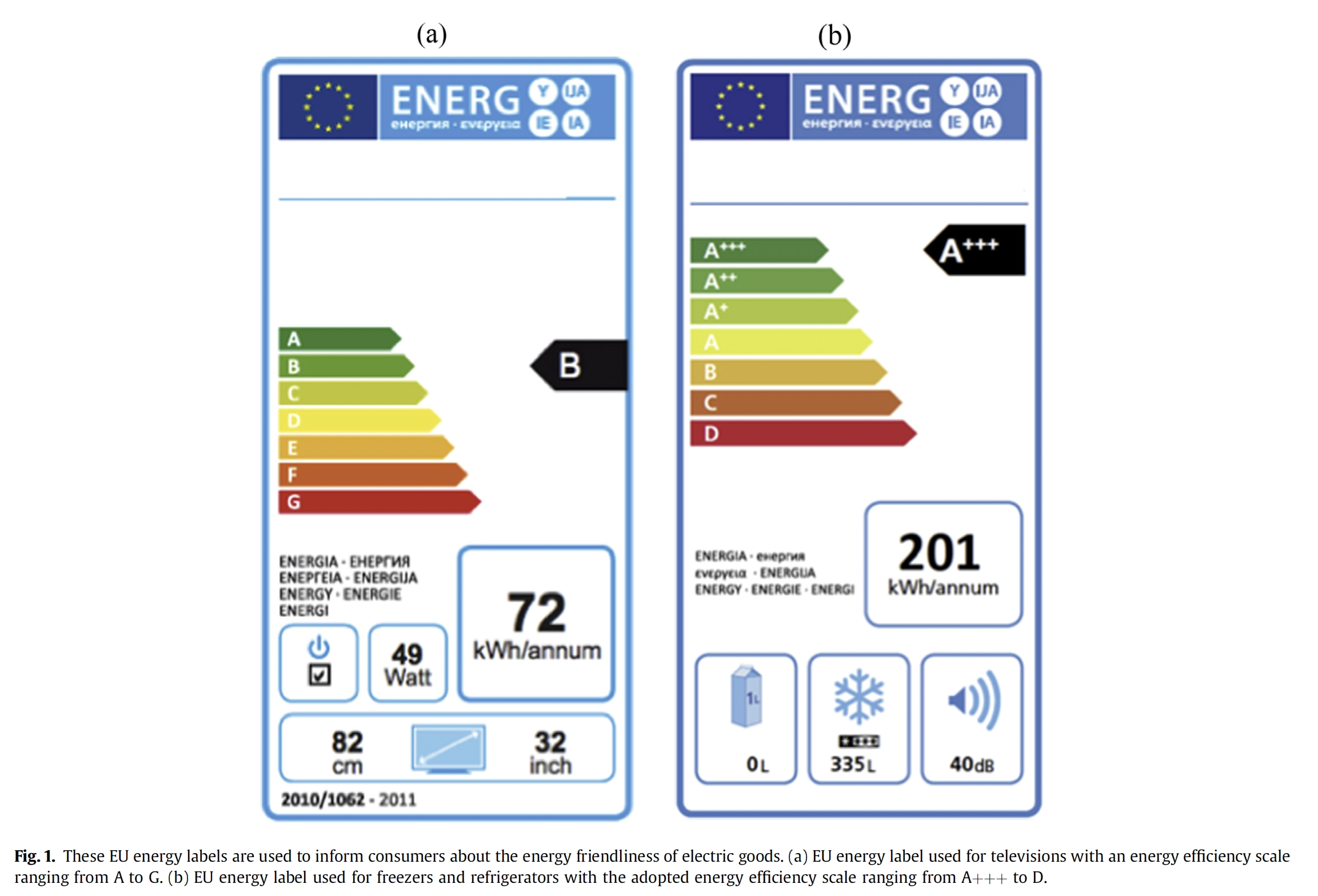
Aim of visuals: The European Union energy label informs consumers at the point of sale about the energy efficiency and electricity consumption of various electric goods. It contains information about its energy efficiency and electricity consumption.
People: Switzerland: 166 online participants, 305 online participants, 166 online participants.
Method: a set of experimental studies
Effect of visuals: Participants were seduced into thinking that a high energy efficiency rating (e.g., A++) means the energy consumption of energy hogs is no longer problematic. As demonstrated in this paper, serious problems in consumers’ decision making may be triggered by this energy label. A set of experiments highlighted the potentially misleading effect of the label and the provided energy efficiency information when estimating the energy friendliness of electric goods.
Suggestions for design: Information about actual energy consumption on the energy label needs to become more
accessible and of equal value to energy efficiency information.
Suggestions for policy: -
Comment: Oddly, the design of the label itself is not discussed? The abstract mentions that the article includes implications for policy makers. These are missing?
Dalhammar C, Richter JL, Machacek E. (2018) ‘Energy Efficiency Regulations, Market and
Behavioural Failures and Standardization’. page 176-228 in: Maitre-Ekern E, Dalhammar C, Bugge HC. (eds.) Preventing Environmental Damage from Products. An Analysis of the Policy and Regulatory Framework in Europe. [DOI]. [A detailed description about the role of labelling and standardization.]
Waechter S, Sütterlin B, Siegrist M. (2015) ‘Desired and Undesired Effects of Energy Labels—An Eye-Tracking Study’. PLoS ONE. 10(7), e0134132. [DOI]. [Putting energy labels on products is often considered an adequate way of empowering consumers to make informed purchase decisions. This paper provides a systematic analysis of consumers’ reactions to one of the most widely used ecolabels, the European Union (EU) energy label, by using eye-tracking methodology as an
objective measurement. The study’s results show that the currently used presentation format on the label is
insufficient.]
Heinzle ST, Wüstenhagen, R. (2012) ‘Dynamic Adjustment of Eco‐labeling Schemes and Consumer Choice – the Revision of the EU Energy Label as a Missed Opportunity?’. Business Strategy and the Environment. 21, 60–70. [DOI].
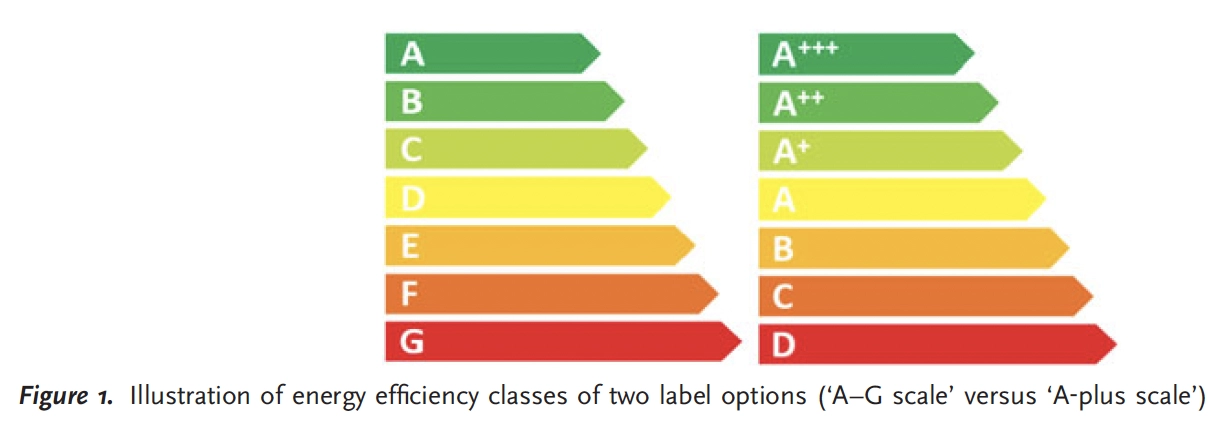
Aim of visuals: By providing information on the environmental performance of products, eco‐labels can guide
consumers towards a more environmentally friendly purchasing behavior.
People: 187 German consumers
Method: stated preferences are derived from preferred choices made under different hypothetical scenarios in experimental markets. Online?
Effect of visuals: This study showed how the effectiveness of a well‐established energy labeling scheme can actually be diminished by the introduction of new rating categories.
Suggestions for design: -
Suggestions for policy: Policy makers can conclude from our study that responding to industry requests for
‘more flexibility’ can result in more complexity for consumers and actually countervail their efforts to increase
consumer awareness about the real energy use of appliances.
Comment: Page 62: ‘there is a huge lack of studies on how consumers recognize, perceive, understand and consider the information on the labels in their purchasing decisions.’ The design of the label is not further discussed.
Ayala A de, Mar Sola M del. (2022) ‘Assessing the EU Energy Efficiency Label for Appliances: Issues, Potential Improvements and Challenges’. Energies.. 15(12), 4272. [DOI]. [The main weakness lies in people’s understanding of its content rather than in its design. The coloured alphabetical EE scale seems to be well understood and the restored A–G scale of the readjusted label positively valued. However, we find comprehension issues with regard to the information on energy consumption and the technical data at the bottom of the label.]